
Nobody Knows I was there, Nobody Knows I was not There: Private Memory
Mixed media 2009
How Reality Is Created
Nobody Knows I Was There, Nobody Knows I Was Not There is among Lin Jingjing’s earliest bodies of work to investigate a question that would continue to run throughout her practice: how reality itself is created.
Across the interconnected series Private Memory, Public Memory, and CCTV News, the artist gradually came to realize that human beings do not merely preserve reality—they continuously produce it. Memory is not simply a container of reality, but one of its producers. History is not a neutral record of the past, but an ongoing reorganization of it. News is not a mirror of events, but a mechanism through which meaning is assigned to those events.
Reality is often understood as something objective: events occur, and thus reality exists. Yet human beings never encounter reality directly. We approach it only through memory, language, history, and media.
Reality is therefore not determined solely by what happened.
It is also shaped by how we remember it, narrate it, and come to believe in it.
Private Memory examines how personal memory creates reality.
Public Memory explores how collective memory creates reality.
CCTV News investigates how media narratives create reality.
Together, these three bodies of work raise an expanding question:
If reality is always preserved, edited, and circulated through various forms of narrative, how much of what we believe to be reality comes from reality itself, and how much comes from the stories told about it?
现实如何被创造出来
《没有人知道我在那,没有人知道我不在那》是林菁菁最早开始追问“现实如何被创造出来”的作品。
在这个由《私人记忆》《公共记忆》与《CCTV News》组成的系列中,艺术家逐渐意识到,人类不仅保存现实,同时也不断制造现实。记忆并非现实的容器,而是现实的生产者;历史并非过去的记录,而是过去的重组;新闻并非事件的镜像,而是事件意义的制造者。
我们通常认为现实是一种客观存在。事情发生了,于是成为现实。然而,人类从来无法直接接触现实本身。我们只能通过记忆、语言、历史和媒介去接近它。
于是,现实并不仅仅来自发生过什么。
现实同时来自我们如何记住它、讲述它以及相信它。
《私人记忆》讨论私人记忆如何创造现实。
《公共记忆》讨论集体记忆如何创造现实。
《CCTV News》讨论媒体叙事如何创造现实。
三者共同构成一个不断扩大的问题:
如果现实总是通过各种叙事被保存、被编辑、被传播,那么我们所相信的现实,究竟有多少来自现实本身,又有多少来自关于现实的讲述?


Private Memory: How Absence Becomes a Form of Presence
Private Memory is based on family photographs spanning more than a century from the artist’s own family archive.
These photographs originally belonged to specific individuals, specific families, and specific histories. By hollowing out the faces of those depicted, Lin fundamentally alters the original meaning of the images. It is precisely through this absence that the work acquires new possibilities.
When a figure no longer possesses a fixed identity, it paradoxically becomes capable of representing anyone.
What once functioned as private family memory gradually detaches itself from personal history and becomes an open emotional space for the viewer.
The more absent the individual becomes, the more universal the memory appears.
The less identifiable the subject is, the more readily the image becomes everyone’s memory.
Here, presence and absence cease to function as opposites.
A person may have departed from reality and yet continue to exist through memory. A figure becomes impossible to identify, and only then begins to activate the viewer’s imagination and emotional projection.
Private Memory reveals a profound paradox:
Absence is not the opposite of existence.
Absence itself is a form of existence.
私人记忆:缺席如何成为一种存在
《私人记忆》使用跨越百年的林自己家族旧照片作为创作素材。
这些照片原本属于具体的人、具体的家庭和具体的历史。然而,被林挖空的面孔改变了照片原有的意义,也正是在这种缺失之中,作品获得了新的可能。
当一个人不再拥有明确身份时,他反而能够成为任何人。
这些原本属于艺术家家族的私人记忆,逐渐脱离个人历史,转化为一种开放的情感空间。
个体越是缺席,记忆反而越具有普遍性。
越无法确认其身份,越能够成为所有人的记忆。
在这里,“在”与“不在”不再是相互对立的状态。
一个人虽然已经离开现实,却持续存在于记忆之中;一个人无法被辨认,才开始影响观看者的情感与想象。
《私人记忆》揭示出一种深刻的悖论:
缺席并非存在的反面。
缺席本身也是存在的一种形式。

Nobody Knows I was there, Nobody Knows I was not There: Public Memory
Mixed media 2011

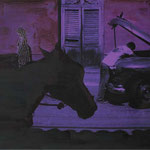
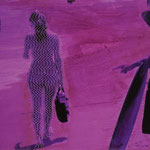


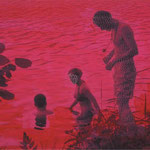


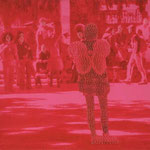


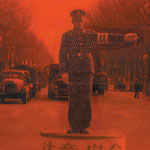


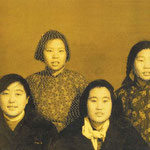


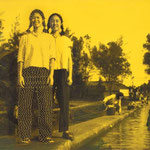

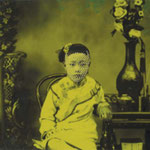


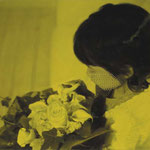
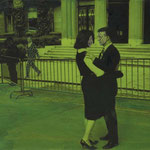

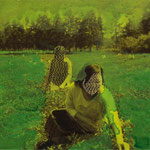


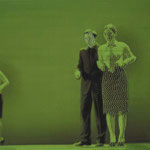

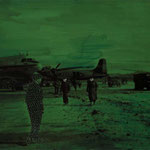


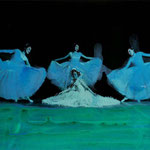


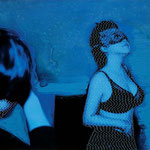


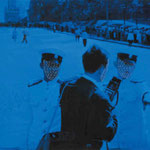



Public Memory: How History Reorganizes Reality
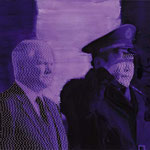
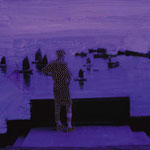
If Private Memory concerns how individuals are remembered, Public Memory examines how humanity is remembered by history.
Figures and historical moments from different periods, locations, and social positions are presented side by side.
Heroes appear alongside ordinary people.
Political leaders appear alongside anonymous individuals.
Major historical events appear alongside seemingly insignificant moments of everyday life.
Together they form a broader portrait of time itself.
History constantly attempts to establish order.
It distinguishes between significance and insignificance, center and periphery, greatness and ordinariness.
Time, however, continuously dismantles those distinctions.
Regardless of whether one was once celebrated or forgotten, powerful or insignificant, every individual ultimately becomes a witness carried along by the same flow of time.
History produces difference.
Time erases difference.
History creates hierarchies.
Time ultimately dissolves them.
Public Memory suggests that history is not an objective preservation of the past, but an ongoing process of selection, editing, and reorganization.
公共记忆:历史如何重新组织现实
如果《私人记忆》讨论的是个体如何被记住,那么《公共记忆》讨论的则是历史如何记住人类。
在这一系列中,不同年代、不同地域、不同身份的人物与历史瞬间被并置呈现。
英雄与普通人并列。
政治领袖与无名者并列。
重大历史事件与微不足道的日常时刻并列。
它们共同构成一幅关于时间的图景。
历史总是试图建立秩序。
它不断区分重要与不重要、中心与边缘、伟大与平凡。
然而时间却不断瓦解这种秩序。
无论曾经辉煌或沉寂,重要或微不足道,所有个体最终都成为时间流动中的共同见证者。
历史不断制造差异。
时间不断抹平差异。
历史试图建立等级。
时间最终取消等级。
《公共记忆》让人意识到,历史并非过去的客观保存,而是一种持续进行的筛选与重组过程。

Nobody Knows I was there, Nobody Knows I was not There: Public Memory
1620 x 405 cm 2015 @de Sarthe Gallery, Beijing


by Yuan-Kwan Chan / Meniscus Magazine)
Lin Jingjing’s work “Public Memory ″ is an impressive panel of 88 photographs, each one measuring 46 by 38 centimeters (18 by 14 3/8 inches). The photos themselves resemble black and white prints of familiar moments throughout one’s life, from current events to film stills, with various solid colors poured in to wash out the whitespace. From afar, the piece serves as a collective, somewhat blurred compilation of famous memories stored in one’s head, shaken out onto a large canvas for visual consumption.
A closer look, however, reveals a modern-day Impressionist twist, as select portions of photographic subjects are actually neatly stitched through with thread, obscured by tiny dashes forming horizontal lines. They represent the idea of how the public recalls, visualizes and even distorts memories over time, and that those fleeting events eventually succumb to color blindness and loss of detail. Internet immortality aside, there is a bit of a chilling realization when one deduces that this inability to remember 100 percent of publicly-known events could also figure into private personal experiences as time passes.
Mizhuang: I’ve noticed that in some of your installations from 2008 and 2009 you used a large amount of film photographs. Is there a certain intent behind this?
Lin: Yes. I really like the texture and material properties of film photographs, especially those that have a bit of age. The passage of time yellows them, warps the colors and damages them. Cracks, folds, fingerprints, stains and moisture change them beyond recognition; moments in time become ashes.
Mizhuang: That’s right. I noticed that you used this particular type of photograph in your installation work “Nobody know I was there , Nobody knows I was not there : Private Memory " . Whose photographs are these?
Lin: These are family photographs, including pictures of my great grandparents, my brothers, my grandparents and my parents’ family members. The photographs span from 1900 to 2000, a century of private photographs.
Mizhuang: I distinctly remember my impressions from seeing this work in the exhibition hall. The exhibition space was very large, and I spotted it from across the room. From afar, my first impression was that it was expansive and poetic, but as I approached it and took in the details, I suddenly tensed up and felt a tingling sensation. I saw all life within those empty outlines, encompassing myself, my family, my sadness and perplexity.
Lin: A photograph is very fragile, yet these fragile carrier bears the weight of infinite meaning.
It is fleeting, yet it serves as the most irrefutable evidence of a certain form of existence;
It is extant evidence, yet it is vanishing evidence;
It affirms a gathering but alludes to parting;
It stores memories and cherishes the past but it also brings injury;
It relieves loneliness and also increases it;
It reminds us of our connections to the past and to others, while also reminding us of the impossibility of connecting with the past and with others;
It chooses our viewing method, yet it does not see our viewing method;
It is touching and yet untouched;
It provides both comfort and discomfort; it is both urgent and indefinite;
It explains the self but is not of the self;
It inserts impossibility and unfamiliarity within the real and familiar; behind that which is not real lays the unobservable truth;
It has powerful virtual authority; it documents and witnesses the ruthlessness of time and the impermanence of life;
It reminds us of the unavoidability of loss, the incurability of suffering; with a sincere profound suffering, it gathers all the scattered people;
From Urgent and Indefinite: the method of paradox Interview with Mi Zhuang

Nobody Knows I was there, Nobody Knows I was not There: CCTV News 2009

Mizhuang: In your work, the paradox formed by ‘presence’ and ‘absence’ gives viewers a powerful mental contrast.
In the work " Nobody knows i was there, Nobody knows I was not there : CCTV News " is from the same series, are the hundreds of photographs from the news?
Lin: Yes, they are all news photographs from CCTV.
I have done much thinking about the concept of ‘news’. One day when I was 30, I was watching the CCTV daily news broadcast, and I suddenly came to the realization that the world does not belong to me, or to anyone for that matter. The world does not and cannot belong to anyone.
In news, there doesn’t have to be any connection between one second and the next. It is in these absurd, seemingly unconnected moments that the world itself becomes connected. If a person’s life is understood through connecting with others, and if this only connection becomes exceedingly strange, then what kind of understanding will result?
Through years of education, Marxism has taught me that human development is inevitable, but every news event I see seems to be completely by chance.
Always at the moment we’re least prepared, the news uses very calm tones to speak of the most terrifying disasters.
This is just like the ruthlessness of life. Who is prepared for the moment when they lose a loved one?
In front of the news, we all become survivors, witnesses to violence, tragedy and disaster. Behind every disaster there is a greater disaster. Each instance of suffering eventually becomes a record of numbers. Every journalist who has reported on a disaster or tragedy moves on to waiting for and discovering the next disaster or tragedy. Who has time to linger on yesterday’s tragedy, even the shocking news from a second ago?
Have you noticed? News reports are so short in every corner of the world, as if the reporters have all undergone the same exact training. It makes us accept tragedy with familiarity, just as we accept celebrations. The news anticipates celebrations and tragedies in the same way, not even placing one before the other. They are watched together by countless viewers before rapidly disappearing, as if they never happened.
Compared to ‘what is happening now’, things like ‘what we have to say’ and ‘what we say’ seem much more important.
Disasters are like culture; they are something we share. This is geography in the truest sense.
Mizhuang: Perhaps our problem is that we don’t know ‘what we have to say’ or even ‘what we can say’.
Lin: Right. On the one hand, it is modern industrial civilization’s endless pursuit of the material, and on the other hand it is the ‘objectification’ of people caused by modern civilization. Materialism has expanded mankind’s interference with the environment beyond its limits, leading to ecological paralysis. The ‘objectification’ of people leads mankind deep into a crisis of meaning.
Massive changes in social ideology and the rise of the internet have led us to separate ‘life’ from the living world. Another side of ‘objectification’ is that it has caused us to separate ‘love’ from the object of our love. Each individual in modern society is haplessly and totally controlled by commercial society, emerging as consumer products which are produced, packaged and sold on a massive scale.
What is the essence of the consumer product? It has been replaced and discarded. Therefore, ‘objectified’ people live in constant fear of ‘falling behind and being discarded’.
Interactions between people have turned into exchanges between objects.
As consumption grows more opulent and diverse, people in an ‘objectified’ society gain more in terms of such factors as self-value, spiritual sense of belonging and sex life, but our emotions grow increasingly empty. Modern civilization and society provide modern people with all kinds of illusory possibilities while misleading them about these possibilities. It provides a consumerist worldview but overturns consumer values. Cruelty can don a glamorous mask, while good intentions get pushed down the road of neglect.
Paradoxes are everywhere.
Mizhuang: That is true. Paradoxes are everywhere. In the installation work " Never Apart ", we see the illusion of coming together and the reality of isolation. Coming together is transient, while isolation is permanent. But the titles take us back to utopia.
Lin: I hope that my artwork can raise issues through paradox and dislocation methods, seeking out the real power of the self’s internal yearnings from the artificial interior of the artwork.
Mizhuang: Let’s return to " Nobody knows I was there, Nobody knows I was not there : CCTV News " . The closest, most central figure in the image is completely empty. It is the ‘self’ in the image, but in actuality, this ‘self’ can be any one of the indistinguishable people in the background. Just as in " Private Memory " , the ‘self’ is not necessarily the artist. Likewise, in the installation work " I want to be with you forever ", the ‘self’ can be the one who is embracing an empty lover, or the empty, embraced ‘self’. ‘You’ can be a person, a country, an object, anything.
Lin: Right. As I see it, art is not about expressing self-experience. This is a very common misconception that people have about art. Art is the thinking that artists reach through their individual experiences. It is a question the artist raises to the self and to the world.
We don’t have to understand our lives or even ourselves, but I think that people must seek out the way in which their lives come together.
By discussing experience, apparently valuable thinking and content that embodies that thought can finally exist independently of the individual.
-- From Urgent and Indefinite: the method of paradox Interview with Mi Zhuang
Nobody Knows I was there, Nobody Knows I was not There Project exhibited @
Songzhuang Art Museum,Beijing, China
White Box Art Museum, Beijing, China
3rd Biennale Italy-China , Dublin, Italy
Galerie Herold,Bremen, Germany
de Sarthe Gallery,Beijing
de Sarthe Gallery Hong Kong
Art Basel Hong Kong
Chile National Art Museum, Santiago, Chile