Urgent and Indefinite: the method of paradox
Interview with Mi Zhuang
Mizhuang: I’ve noticed that in some of your installations from 2008 and 2009 you used a large amount of film photographs. Is there a certain intent behind this?
Lin: Yes. I really like the texture and material properties of film photographs, especially those that have a bit of age. The passage of time yellows them, warps the colors and damages them. Cracks, folds, fingerprints, stains and moisture change them beyond recognition; moments in time become ashes.
Mizhuang: That’s right. I noticed that you used this particular type of photograph in your installation work “Nobody know I was there , Nobody knows I was not there : Private Memory " . Whose photographs are these?
Lin: These are family photographs, including pictures of my great grandparents, my brothers, my grandparents and my parents’ family members. The photographs span from 1900 to 2000, a century of private photographs.
Mizhuang: I distinctly remember my impressions from seeing this work in the exhibition hall. The exhibition space was very large, and I spotted it from across the room. From afar, my first impression was that it was expansive and poetic, but as I approached it and took in the details, I suddenly tensed up and felt a tingling sensation. I saw all life within those empty outlines, encompassing myself, my family, my sadness and perplexity.
Lin: A photograph is very fragile, yet these fragile carrier bears the weight of infinite meaning.
It is fleeting, yet it serves as the most irrefutable evidence of a certain form of existence;
It is extant evidence, yet it is vanishing evidence;
It affirms a gathering but alludes to parting;
It stores memories and cherishes the past but it also brings injury;
It relieves loneliness and also increases it;
It reminds us of our connections to the past and to others, while also reminding us of the impossibility of connecting with the past and with others;
It chooses our viewing method, yet it does not see our viewing method;
It is touching and yet untouched;
It provides both comfort and discomfort; it is both urgent and indefinite;
It explains the self but is not of the self;
It inserts impossibility and unfamiliarity within the real and familiar; behind that which is not real lays the unobservable truth;
It has powerful virtual authority; it documents and witnesses the ruthlessness of time and the impermanence of life;
It reminds us of the unavoidability of loss, the incurability of suffering; with a sincere profound suffering, it gathers all the scattered people;
Mizhuang: In your work, the paradox formed by ‘presence’ and ‘absence’ gives viewers a powerful mental contrast.
In the work " Nobody knows i was there, Nobody knows I was not there : CCTV News " is from the same series, are the hundreds of photographs from the news?
Lin: Yes, they are all news photographs from CCTV.
I have done much thinking about the concept of ‘news’. One day when I was 30, I was watching the CCTV daily news broadcast, and I suddenly came to the realization that the world does not belong to me, or to anyone for that matter. The world does not and cannot belong to anyone.
In news, there doesn’t have to be any connection between one second and the next. It is in these absurd, seemingly unconnected moments that the world itself becomes connected. If a person’s life is understood through connecting with others, and if this only connection becomes exceedingly strange, then what kind of understanding will result?
Through years of education, Marxism has taught me that human development is inevitable, but every news event I see seems to be completely by chance.
Always at the moment we’re least prepared, the news uses very calm tones to speak of the most terrifying disasters.
This is just like the ruthlessness of life. Who is prepared for the moment when they lose a loved one?
In front of the news, we all become survivors, witnesses to violence, tragedy and disaster. Behind every disaster there is a greater disaster. Each instance of suffering eventually becomes a record of numbers. Every journalist who has reported on a disaster or tragedy moves on to waiting for and discovering the next disaster or tragedy. Who has time to linger on yesterday’s tragedy, even the shocking news from a second ago?
Have you noticed? News reports are so short in every corner of the world, as if the reporters have all undergone the same exact training. It makes us accept tragedy with familiarity, just as we accept celebrations. The news anticipates celebrations and tragedies in the same way, not even placing one before the other. They are watched together by countless viewers before rapidly disappearing, as if they never happened.
Compared to ‘what is happening now’, things like ‘what we have to say’ and ‘what we say’ seem much more important.
Disasters are like culture; they are something we share. This is geography in the truest sense.
Mizhuang: Perhaps our problem is that we don’t know ‘what we have to say’ or even ‘what we can say’.
Lin: Right. On the one hand, it is modern industrial civilization’s endless pursuit of the material, and on the other hand it is the ‘objectification’ of people caused by modern civilization. Materialism has expanded mankind’s interference with the environment beyond its limits, leading to ecological paralysis. The ‘objectification’ of people leads mankind deep into a crisis of meaning.
Massive changes in social ideology and the rise of the internet have led us to separate ‘life’ from the living world. Another side of ‘objectification’ is that it has caused us to separate ‘love’ from the object of our love. Each individual in modern society is haplessly and totally controlled by commercial society, emerging as consumer products which are produced, packaged and sold on a massive scale.
What is the essence of the consumer product? It has been replaced and discarded. Therefore, ‘objectified’ people live in constant fear of ‘falling behind and being discarded’.
Interactions between people have turned into exchanges between objects.
As consumption grows more opulent and diverse, people in an ‘objectified’ society gain more in terms of such factors as self-value, spiritual sense of belonging and sex life, but our emotions grow increasingly empty. Modern civilization and society provide modern people with all kinds of illusory possibilities while misleading them about these possibilities. It provides a consumerist worldview but overturns consumer values. Cruelty can don a glamorous mask, while good intentions get pushed down the road of neglect.
Paradoxes are everywhere.
Mizhuang: That is true. Paradoxes are everywhere. In the installation work " Never Apart ", we see the illusion of coming together and the reality of isolation. Coming together is transient, while isolation is permanent. But the titles take us back to utopia.
Lin: I hope that my artwork can raise issues through paradox and dislocation methods, seeking out the real power of the self’s internal yearnings from the artificial interior of the artwork.
Mizhuang: Let’s return to " Nobody knows I was there, Nobody knows I was not there : CCTV News " . The closest, most central figure in the image is completely empty. It is the ‘self’ in the image, but in actuality, this ‘self’ can be any one of the indistinguishable people in the background. Just as in " Private Memory " , the ‘self’ is not necessarily the artist. Likewise, in the installation work " I want to be with you forever ", the ‘self’ can be the one who is embracing an empty lover, or the empty, embraced ‘self’. ‘You’ can be a person, a country, an object, anything.
Lin: Right. As I see it, art is not about expressing self-experience. This is a very common misconception that people have about art. Art is the thinking that artists reach through their individual experiences. It is a question the artist raises to the self and to the world.
We don’t have to understand our lives or even ourselves, but I think that people must seek out the way in which their lives come together.
By discussing experience, apparently valuable thinking and content that embodies that thought can finally exist independently of the individual.
Mizhuang: During the artistic creation process, and even after the process, what do you think is the connection between you and your artworks?
Lin: At the beginning of the creative process, I have a sense of possession of my expressive methods. It is my ‘object’. It is just like photography to the photographer – it is a hypothetical possession.
The unfolding and implementation of the creation is a process of constantly seeking the appropriate descriptive methods and balance points. Once the descriptive methods and the balance of methods are found, then the artwork is complete; the artwork and its expressive method have been restored to the state of ‘other things’ that are outside of me. I feel that it has become detached from me, and now bears very little connection to me. It needs to connect with the living experiences of other viewers. Though it is something that I created, the audience has no need for pondering how or why I made it. What matters now is how that work affects their individual lives and what thinking it elicits.
The work of art to the artist is like the child to the mother. The child is brought about by the mother, but it does not come for the mother.
Mizhuang: I’ve noticed that your main focus has always been the understanding of life.
Lin: The quest to understand life is more real than culture and it transcends culture, history and politics.
Mizhuang: This reminds me of another of your photographic works, My 365 Days. Though it is presented as a photographic work, I consider it to be a work of performance art. In these diary-style photographs from 365 days we see the hair that comes out of your comb each day, silent yet direct, essential and profound.
Lin: Just a few months ago I was flipping through a magazine and came across a photo essay about families who had lost their children in the Sichuan earthquake and were now pregnant again. They had all had children aged from 8 to 14, but they had died in the earthquake. Now, these mothers harbored new young lives in their swollen bellies. They were no longer young, and looked fragile, weary and tattered, with the calm of someone dealt a heavy blow. They rose up from their tears and prepared to conquer terror and hopelessness with new life.
I found this deeply moving. It is the essence of life.
One day we will lose our loved ones, whether from separation or death. Every life will face this suffering sooner or later, the loss of hope. In the face of life’s brutality, we are all weak and innocent. Our simple attitudes cannot relieve this suffering. But this is an important component of life. To understand brutality is to cherish the life that we still have.
Mizhuang: I was moved in the same way by " Rose Rose ", especially the video segment.
The rose is our life; it undergoes the constantly intertwining splendor and brutality of life.
From your earliest poetry compositions to today’s art, you’ve made quite a leap. I’m curious; can we talk about your childhood? I’d like to understand the experiences that led you to choose poetry. Are there any stories from your childhood that influenced you, that continue to influence you today, influencing your thoughts and your creations?
Lin: Among the various forms of literary expression, poetry is the most versatile and indistinct. It can be fully without logic yet full of rhythm; it can be abstract, even stagnant, but it is free and beyond limitation, full of vast, inexhaustible power.
I really like these qualities. I think that poetry is closest to the soul. It has shown me the true, touching aspect of ‘bounding conception’.
I had a very lonely childhood with almost no friends. I don’t know why. This was especially the case when I was 5, 6 years old, because all of the children near my home were a few years older than me. For children at this age, this is a wide gulf, one that is difficult to cross. Back then I was jealous of all the rowdy boys running about, with their big, boisterous groups, calling out as they charged into one exciting game after another.
Mizhuang: Did you think about joining them?
Lin: Of course I did. I really wanted to, and I tried, but I discovered that the world of boys is a brutal one. For boys, the meaning of violence far surpasses that of anything else. Violence was a part of everyday existence in the 1970s; participation in and the production of violence created glory and satisfaction, and an un-discussed consensus formed around the tacit acceptance of it. This acceptance naturally split people off into rapidly aligning cliques.
In fact, I think that in the 1970s, under a blind and factious mental state, violence was emphasized and fanned to the point of the mundane; violence established a kind of consensus, no matter how illusory. In those times, consensus was most important.
For instance, someone that we all respected passed away, but we established a consensus method for cherishing that person, and this instantly became a lofty, dignified affair. In this atmosphere of consensus, we shed sweet tears, and our shared love for this person became perpetual.
The young me didn’t feel sorrow at all, just an indescribable sense of the sublime.
Consensus is a powerful rationale for violence to become reasonable and legitimate. In consensus, ‘brutality’ and ‘insanity’ become exciting.
Consensus-backed violence is approved, eulogized, worshipped and understood. Consensus-backed violence is legitimate and virtuous, in keeping with emotions and political standpoints.
Violence turns people into ‘objects’; it is the slaughter of ‘objects’ by ‘objects’. Though those ‘objects’ may appear as martyrs or heroes, this cannot change the essential nature of violence.
Mizhuang: These thoughts were also manifested in your 2009 painting series Another Way to Fly. The images featured fighter jets that were built for violence and war, which you covered in beautiful, transparent lace. Is violence bathed in the soft glow of sentimentality still violence? If it is no longer violence, then what is it? What have we made it into?
Lin: The violence here is a metaphor. The discussion of real violence is one aspect. This was more of an exploration of the concepts surrounding violence, the attitudes people have towards violence, even the relationships between modern people. These have all been gradually reduced to a relationship of mutual violence between ‘objectified’ people. This is violence using rather abstract means to continue to embody the consensus of the 1970s in today’s seemingly peaceful world.
None of us want those who were sacrificed in the various forms of violence to call out, like the soldier in J’Accuse, “our sacrifice has been for naught”.
The violence of those boys I knew as a child often played out in my imagination. For a time in my childhood my imaginations and fears of violence became excessive. It was clear that I yearned to join them, but they were very rough with me, especially the youngest boy.
Mizhuang: How old was the youngest boy?
Lin: He was a few months older than me, about my age, but he was the youngest in the group. The oldest boy in the group was two or three years older than him, so this young boy was often also excluded. The older boys would make fun of him, saying that he couldn’t keep up or wasn’t brave enough, so he was under a lot of pressure. He really wanted them to recognize him and see him as part of their group.
I would often secretly follow them. I was very curious about them. I wanted to know everything they were doing, where they were going. When they would discover me, they would stop what they were doing, split up or run off together, taking side streets, jumping over walls or climbing trees to lose me.
Each time they succeeded in losing me was a victory to celebrate. My tears were always accompanied by their cheers from the distance. It made me sad.
Mizhuang: Did it hurt? (Laughs) Was your young soul already wounded?
Lin: I wouldn’t say wounded; at the time I felt that these conflicts were normal. I was the one who chose to spy on them indirectly, shamelessly tailing them. Of course I had to accept the consequences.
I clearly remember this one time where I was following their sounds when the youngest boy jumped out behind me from a tree. He was holding one of those cheap green folding knives that you use to sharpen pencils. He brandished it at me, and with an evil look in his eyes, said some very foul things.
Mizhuang: How did you react?
Lin: I was very angry. I felt that my dignity had been violated. I glared at him, and dared him to repeat it. He immediately repeated it. I got even angrier and dared him to say it again, which he did immediately.
Then I asked if he dared to say it a hundred times.
He was dazed. His mouth moved, but he didn’t make a sound. He put his knife away and ran off without looking back.
Mizhuang: That’s very interesting. What were you thinking?
Lin: I don’t believe it was something I could have really thought out, more of an instinctive reaction. In some impossible way it saved my self-respect and honor, but it also gave me a powerful message – that when you let something become absurd, it will turn into something else, and its qualities and direction are all subject to change. The thing that had dazed that boy actually never really existed. It was a kind of existence that comes from the infinite propagation of reality. Though this infiniteness is not real, it is enough to be absurd. It is a different kind of truth within untruth, the truth of invisible truth, the untruth that overturns truth, the persistence of absurdity. In fearlessness and certainty, it creates power. That boy’s retreat was the retreat of the imagination.
Many years later, I realized that this can be my contemporary art method.
既迫在眉睫,又遥遥无期:悖论的方式
( 林菁菁艺术访谈)
米庄:我注意到你在2008年和2009年创作的几件装置作品里都大量地用相纸照片,这是有意为之的吗?
林: 对,我非常喜欢相纸照片的质感和材料性,尤其是有了点年头的相纸,岁月的流逝令之发黄,变色,破损,出现裂纹,折痕,留下指纹,污渍,受潮的地方面目全非,片刻之间可化为灰烬。
米庄:对,我注意到你的装置作品《没有人知道我在那,没有人知道我不在那:私人记忆 》中正好使用了这个类型的照片,这些照片都是谁的照片呢?
林:是我本人的家族照片,其中有我的祖父母的父母,兄弟,祖父母,父母的家人和亲戚,时间上我选择的是从1900年一直到2000年,一百年来的私人照片。
米庄:我还很清楚地记得我在展厅看到这件作品的感受,展厅高又开阔,我远远地在展厅的另一头就看见它,第一眼是舒展的,诗意的,到了近处,看见了细节,我有心忽然收紧的感觉,一阵刺痛,我在空洞的轮廓中看到了所有的生命,这其中就有我自己,我的家人,我的悲伤和迷惘。
林:相纸照片非常脆弱,而正是这么一种脆弱的载体,却肩负着无比强大的涵义。
它是存在的证据,也是消失的证据;
它自身朝不保夕,却同时是某种存在最不可辩驳的证据;
它证实相聚,也提示分离;
它储存了记忆,缅怀过去,又带来创伤;
它缓解孤独,也加剧孤独;
它提示我们和过去和他者的联系,也提示我们和过去和他者的不可联系;
它选择我们的观看方式,又无视我们的观看方式;
它既是饱含感染力的,又是无动于衷的;
它同时提供安慰和不安,即迫在眉睫,又遥遥无期;
它说明了我,即非我;
它在真实和熟悉中夹杂着不真实和陌生,它的任何不真实的背后,恰恰是最不被察觉的另一个真实;
它拥有着虚拟的强大的权利,它纪录和见证着时间的残酷,生命的无常;
它提示着消失的不可避免,悲痛的不可治愈,它以一种诚挚而深刻的痛苦聚合了所有分散着的人们。
米庄:你的作品中“在”和“不在”形成的悖论,带给观众巨大的心理落差。
同系列的作品《没有人知道我在那,没有人知道我不再那:中央新闻》中数百张照片都是新闻照片吗?
林:对,全部来自中央电视台的新闻照片。
我仔细思考关于“新闻”的概念,是在我30岁的某一天,我看着CCTV的新闻联播,我忽然意识得世界并不是我的,世界甚至不是我们中任何人的,世界是我们任何人都不拥有,也不可能拥有的。
新闻的前一秒钟和后一秒钟完全可以毫无关联,世界本身就在这种荒诞的看起来不可关联的时间中联系起来,如果一个人的生命是通过和其他人的联系而得到理解,如果这唯一的联系正在变得匪夷所思,那么,我们得到的理解会是什么?
多年受教育,马克思主义告知我,人类的发展是一种必然,而我看到的所有的新闻事件却似乎完全是偶然的。
新闻总在我们没有任何防备的那个时刻,用非常平静的语调,说出最可怕的灾难。
这一点和生命一样残酷,当我们失去我们所爱的人的那一刻,我们中的谁,是有防备的?
在新闻面前,我们都成了幸存者,成了暴力,不幸和灾难的旁观者,每一个灾难后面都有一个更大的灾难,每一次痛苦都逐渐变成对数字的记录,那些报道过灾难和痛苦的记者,已经忙碌地投入到对下一个灾难和痛苦的等待和发现,谁有时间停在昨天的悲伤,哪怕是上一秒种的新闻震撼?
你注意到了吗?在全世界的任何一个角落,新闻的播报都那么简短扼要,仿佛全部的播报员都受过统一的训练,它让我们熟悉地习惯地,象接受庆典一样接受灾难,而新闻本来就把庆典和灾难同等对待,甚至挂上不分排名先后的标志,他们被无数的旁观者共同观看,然后迅速同时地消逝,仿佛从来没有发生过。
比起“什么是正在发生的”,“我们有什么话要说”和“我们说什么”,显然是更重要的。
灾难和文化一样,都是我们共有的,这才是真正意义的地理学。
米庄:我们的问题也许正是不知道 “我们有什么话要说”,也不知道“我们可以说什么”。
林:对,一方面,是现代工业文明的对物质的无休止追求,另一方面,是现代文明对人的“物化”,
物质主义使人类对生态系统的干预力度超出极限,最终导致生态系统的瘫痪,对人的“物化”则使人类深陷意义危机。
由于社会意识形态的巨变,互联网让我们把“生活”和生活的世界分开,“物化“情感中的另一方,让我们把“爱”和爱的对象分开,现代文明中的每个人,都在不由自主地接受商品社会的整体操作,以消费品的面貌出现,被制作,包装,从而最大限度地被出售。
消费品的本质是什么? 是被取代和抛弃,因此,被“物化”的人们不由自主地生活在“接不了轨,跟不上趟,或将被淘汰和抛弃”的恐惧中。
人和人的交往成了“物”和“物”的交换。
一方面生活消耗越来越多样昂贵,人们在互为“物化“的社会中获取自我价值,精神归属,性生活等生命要素, 另一方面,我们的感情越来越空乏,现代文明社会给现代人提供幻想的种种可能性,也误导这种可能性,提供消费世界观,又推翻消费的价值观,冷酷可能带着华丽的面具,善意也可能走向失道寡助的不归路。
处处都是悖论。
米庄:处处是悖论,的确如此,你的装置作品《永不分离》中聚合的幻像和实际的分离,聚的稍纵即逝,离却不可回避,但是作品的标题却把我们带回乌托邦。
林:我希望我的艺术能够以悖论错离的的方式提出问题,从作品中某种人为的不真实的内部,寻找来自生命的“我”的内在渴望的真实的力量。
米庄:我们回到作品《没有人知道我在那,没有人知道我不在那:中央新闻》,作品中离我们最近,处于图片最中心位置的主体人物全是空缺的,是作品中的“我”,但是实际上,“我”也可以是背景中那些成群的辨别不清面容的其中任何一位,和《私人记忆》一样,“我”并不是艺术家这个“我”。同样,装置作品:《我要永远和你在一起》中,“我”可以是拥抱空缺情人的“我”,也可以是被拥抱着的空缺着的“我”,“你”可以是“人”,可以是“国家”,可以是“物”可以是任何一种可能。
林:对,在我看来,艺术并不是为了表达和呈现自我经验,这通常是人们对艺术家的巨大误读,
艺术是艺术家从个体的生存体验中获得的思考,是艺术家向自我,向世界的提问。
我们可以不理解我们的生活,甚至不理解我们自己,但我认为一个人需要去寻找和发现他自己的生命构成方式。
谈论经历,谈论体验,其实是通过经验,让一些看起来有价值的思考和体现思考的内容,能够最终脱离个人而存在。
米庄:那么在艺术创作的过程中甚至之后,你觉得你和作品之间的关系是怎样的?
林:创作初始,我对我的表达方式有一种占有感,它是我的“物”,就像拍摄对于摄影师而言一样,是一种被假设的占有。
创作的展开,实施,是不断寻找恰如其分的陈述方式和最贴切的平衡点的过程,陈述方式和方式平衡点确定,艺术作品完成,作品本身和表达方式都还原为外在于我的“其他物”,我认为它就脱离了我,和我的关联也微乎其微了。它需要更多地和观者的生命体验联系在一起,它虽然是我创造的,但是观者无须揣摩我的“怎么作”和“为何而作”,而关心作品对他的个体生命的影响,以及之引发他个人怎样的思考。
作品之于艺术家,正如孩子之于母亲,孩子可以经由母亲而到来,却不是为了母亲而来。
米庄:对,我发现你的关注点始终是对生命的理解。
林:探讨对生命的理解,比文化更真实,而且超越文化,历史,政治。
米庄:这让我想起你的另外一件摄影作品《我的365天》,虽然呈现的是摄影作品,我认为其实是一件行为作品,日记般拍摄了365天,每天梳头的时候掉落的头发,无声,但是直接、本质,深刻。
林:就在几个月以前,我无意间在一本杂志上,见过一组拍摄汶川大地震丧子家庭再生育孕妇的照片,她们全都有过一个8到14岁的孩子,不幸在地震中遇难,她们隆起的腹部都孕育着另一个幼小的生命,她们都青春不再,都显得那么柔弱,沧桑,疲惫,憔悴,带着重创之后的平静,默默地含着眼泪坚强起来,准备和新生命一起来战胜恐惧和绝望。
这使我非常感动,这就是生命的本质。
我们有一天,会失去我们爱的人,或是分离,或是死亡,所有的生命,都或迟或早终究面对这样的疼痛,将没有柳暗花明;在生命的残酷面前,我们都是脆弱的,无辜的,无奈的,我们简化的态度并不能缓解这样的悲痛,但是,这正好是生命重要的一个组成部分,认识残酷,意味着加倍珍惜我们仍然拥有的生命。
米庄:我在你的《玫瑰 玫瑰》中获得同样的感动,尤其是那段录像。
玫瑰就是我们的生命,它经受的正是生命中不断混杂在一起的炫丽和残酷。
从最早的诗歌写作,一直到你今天的艺术,其中的跨度是相当大的, 我有点好奇,能聊一聊你的童年吗?我想了解,是怎样的经历,让你选择了诗歌写作?或者说,有没有任何童年的故事,曾经影响过你,甚至直到今天,还在影响着你,影响着你的思考,影响着你的创作?
林:诗歌是所有文字表达里最跳跃,最模糊的一种,它可以没有逻辑,但是充满节奏,它可以抽象,甚至静止,但是自由,超越极限,带着永不枯竭,汹涌不已的力量。
非常喜欢它这种特质,我觉得它最靠近心灵,让我看到“跳跃着的观念”的真实而感人的部分。
我有一个特别寂寞的童年,朋友很少,几乎没有,不知道是什么原因, 尤其是5,6岁的时候,住在我家周围的孩子要么比我大2,3 岁,要么比我小2,3 岁,这对一个孩子来说,是很大的鸿沟,很难逾越,那时我非常羡慕那些打打闹闹,奔过来跑过去的男生,他们总是一群一群的,大喊大叫,呼啸着投入一个又一个激动人心的游戏。
米庄: 那你想过加入他们吗?
林: 当然想过,渴望极了,也试过,我发现,男孩的世界其实是很残酷的,暴力对于男孩的意义远胜于任何其他,暴力是70年代的日常存在,参与暴力和制造暴力能造就光荣和满足,它在无需谈论的共识中达到默契,而这种默契,使人和人自然分群,并迅速地亲密地团结到一起。
实际上,我认为在中国的70年代,在一个盲目而分裂的精神状态中,暴力被日常性地强调和煽动,暴力建立起一种共识,尽管可能是幻觉也无关紧要,因为在那个年代,共识才是最重要的。
比如一位我们共同敬爱的人,死去,但是我们建立了共识的方式缅怀死者,这立刻变成一件多么有尊严而高贵的事情,我们在达到共识的气氛里甜蜜地哭泣,我们共同爱着的这个人成为永恒。
幼年的我并没有感到悲伤,我只感到的是不能描述的崇高。
共识也是暴力成为合理合法的强有力的理由,“凶残”和“疯狂”都在共识中变得令人兴奋。
达成共识的暴力是被允许的,被歌颂的,被推崇的,被理解的,达成共识的暴力是合法而且道德的,是符合情感和政治立场的。
暴力也促使人变成“物”,是“物”对“物”的毁灭和屠杀,尽管“物”可能以烈士或者英雄的名义呈现,那也不能改变暴力本身的性质。
米庄:这些思考,我在你2009年的绘画系列作品《 飞翔的另一种方式》中也体现了,画面上是一架架为了暴力和战争而建造的战斗机,你却在画面上蒙上一层透明而且美丽的蕾丝,暴力在闪着温情的淡淡的光芒中,暴力还是暴力吗?如果不再是暴力,那到底是什么,我们究竟让他们成为了什么?
林:对,这里的暴力是一个比喻,谈论真实的暴力是一方面,我其实更多的是在探讨关于暴力的观念,人们面对暴力的态度,甚至是现代人和现代人之间的关系,逐渐简化成相互“物”化之后的暴力关系,这是暴力以相对抽象的方式,在看似和平的今天,继续地体现着70年代的共识。
我们都不愿意,在各种各样的暴力中牺牲的人,就象在法国电影《我控诉》中那位军人喊的那样:“你们全都白白牺牲。”
我童年时认识的那些男孩,他们的暴力,在我这里常常是想象的演示, 我的一部分童年就在对暴力的想象和恐惧中渡过,我希望加入他们“那一伙“的渴望是显而易见的,但是他们对我很粗暴,尤其是他们中最小的男生。
米庄:最小的男生多大?
林: 比我大几个月,基本上和我同龄,但是他是他们那一群里最小的,那群孩子里,大的也大他2,3岁,所以他有时也受排挤,大孩子有时会取笑他,嫌弃他跟不上,不够勇敢等等,所以他也有压力,他特别渴望得到大孩子们的认可,他特别渴望大孩子们认为他和他们是一伙的。
我经常偷偷地跟着他们,我对他们非常好奇,我想知道他们作的任何事情,我也想知道他们都去了哪里,我对他们的追随都在某一个或者一群男生的喝斥中索然而止,或者是他们一起,故意跑得特别快,抄各种小路,翻墙攀树,把我甩掉。
每一次成功地甩掉我,就意味着一个可以共同庆祝的胜利,我的沮丧总是伴随着他们在不远的远处发出的欢呼,总让我心有不甘。
米庄:那你不是很伤心?(笑)是不是幼小的心灵已经受到了伤害?
林:谈不上伤害,那时候觉得这些冲突是正常的,是我自己主动而且不间断地老是偷窥,还无休止地跟踪尾随,自然需要承受任何后果了。
我记得很清楚,有一次,我正寻着声音跑,那个最小的男孩从一棵树的后面跳出来,手里握着一把削铅笔用的小刀,那种薄薄的绿绿的,廉价的简易的折叠小刀,朝我打开着,他非常凶恶地盯着我,说了一句非常恶毒的脏话。
米庄:当时你的反应是什么?
林:我非常愤怒,我觉得我的尊严受到了侵犯,我紧紧地盯着他:你敢再说一遍?
他立刻再说了一遍。我更愤怒了:你敢再说一遍? 他立刻又说了一遍。
然后我说:你敢再说一百遍?
他一下子楞了,楞过那一瞬那,他动了动嘴唇,什么也没说,收起小刀,头也不回地跑了。
米庄:这很有趣,你当时是怎么想的?
林: 我相信那不是当时可以认真想出来的,是一个直觉的反应,它以不可能的方式,拯救了我的自尊和荣誉,但它给了我一个很强的信息,那就是:当你让某件事情变得荒唐了之后,它会变成另外一个东西,它的性质和方向就都可以改变。实际上,令那个男孩恍惑的东西并不存在,它是现实以无限的方式衍生之后的存在,这样的无限虽然虚拟,但是足以荒诞,它是不真实中的另外一种真实,是无视真实的真实,是颠覆真实的不真实,是对荒诞的坚持,无惧和不容置疑,它就这样产生了力量,那个男孩的退却是想象力的退却。
很多年以后,我仔细地想,这其实就可以是当代艺术的方式。
Color of Memory
Lin Jing jing interview with Mi zhuang (2)
Mizhuang: Your work Color of Memory invited different people to enter into the artwork. Did you have any special criteria for the people you chose?
Lin: The people came from different backgrounds, different professions, different genders and different ages. I asked them the same three questions, all about their most painful memory.
Mizhuang: This is very interesting. You asked them to use a special way of recognizing and transferring their private memories.
Lin: Right. First they transform an abstract memory into a concrete object, then transform it into an abstract color.
Mizhuang: Their answers came to directly form the content and methods of your artwork.
Lin: Right. The narrative and transfer of information was theirs, and then I, as an observer, used the colors they described to paint an “object” that they described as having a close connection to their memory. I rendered and transformed their information.
Mizhuang: I noticed that you intentionally separated the sound and visuals in the narration videos. All of the people recounting their stories alone, when they stare into the camera and slowly speak; it feels calm and real, with no glossing over. The sound of their narratives is stiff; you rendered it into a staccato style, with each word being hammered out one at a time. To be honest, it really hit me.
Lin: Each segment is very severe, sorrowful and hesitant. The pain seems to belong to the speaker, and has been compressed into an unknown corner, where hidden wounds cause constant disruption. But in the recounting of this pain, it gradually separates and exists outside of the speaker, away from the pain of the experience. To recount the past is to create anew. Its realness shocks us, to the point that we almost don’t dare to face its realness. Pain can alter our normally numb state, but it can also make us grow number. This is a paradox. One person grew up under the shadow of his dead older brother. This brother, who he has never seen, perpetually hovers over every road he must cross. In the face of death, he is superfluous, imperfect, unreal. This painful memory has overshadowed him for thirty years, never fading away. When I asked him the second and third questions, he said: a medicine bottle full of pills. White, an extremely pale white. I believe that what shocks you is not the pain itself. Pain is not about individual experiences; it is about natural philosophy.
Mizhuang: Have you compared these different experiences?
Lin: I don’t look for the differences between these painful memories, I look for their commonalities. Extreme pain and grief are often caused by abandonment, sickness and death, or even abstract fear of one of the above, worry about potential danger and its unpredictable arrival. Through recognizing pain, we recognize all life, recognize our shared fears, desires, earnestness, control and balance. We face the fact that fear can never be truly avoided, face the fact that hopelessness can come out of nowhere, face the fact that pain magnifies our fears, doubts and weaknesses.
What matters is not what kind of pain we experienced. What matters is: what does that pain bring us? What does the most frightful pain we experience turn us into? When faced with enormous pain, what do freedom, dignity, even our lives mean?
But, what’s really interesting is that fear has always been a useful weapon in politics and power. Fear can spark unimaginable courage in people. Fear can drive people to die for nonexistent reasons.
Every day is filled with news of violence and disaster, constantly reminding us that sorrow and injustice are unfolding in every corner of the globe. A security-seeking mentality has become the mainstream. Fear has become a public sentiment, and its scope is continuing to expand, while trust is becoming a luxury. There will never be a book that better explains the pressures of modern life than the bestselling I’m Afraid, You’re Afraid: 448 Things to Fear and Why.
The pursuit of “lightning speed” is the goal of modern technology, as well as our spiritual support. New technology has altered our conception of time, our level of patience for processes and our level of caution in trust. In reality, education does not seem interested in these ideas. Today’s education has not effectively connected with today’s world.
Math education shouldn’t only focus on learning arithmetic. It should work to cultivate certain ways of thinking as it explains things. Geography and history shouldn’t be single, separate knowledge systems. Beyond telling young students what is happening and what there is in the world, we need them to learn how to think about what we all face in common. It will no longer be about gaining and accepting knowledge, but about categorizing, organizing and rearranging knowledge. The goal of receiving an education is not to gain knowledge, but to gain freedom through knowledge.
Mizhuang: Your work The Possible of the Impossible brings people who have no connection to art to take part in your artwork. What is your reasoning behind this?
Lin: In today’s so called highly effective life, on the one hand, we pursue speed and quantity. We want everything as fast as possible and as much as possible. We rely too much on objects and technology, while the spiritual side is growing diminished. Truth, sincerity and straightforwardness are tending towards impossibility. The Possible of the Impossible took place in the commercial space of a high end office building. In this space, the audience and I had a very natural (or serendipitous) relationship of influencing and watching each other. For the audience, a rather non-commercial activity is taking place in this commercial space with unclear motives, which is confusing and suspicious. For me, this in itself was my artwork. There’s no transition or boundary between the inside of the artwork and the outside.
Mizhuang: This is very interesting. This transcends the artwork in the normal sense, adding a series of uncertainties to the content. What were the results of the dialogue like?
Lin: To put it precisely, the dialogue is a process, a process of casting doubt, casting doubt on the rationality of everyday life, on the accuracy of accustomed ideas, on reasons for existence, on means of existence, on what is pressing, on what makes us fall silent, on how pressing matters become unimportant, on possible limits. We live in a brutal, heartless world that runs like a massive factory. We must find the possible in the impossible through skepticism.
Mizhuang: To find the possible in the impossible. It sounds quite paradoxical.
Lin: Right. Paradoxes are still what I am most interested in at this stage. Living in today’s paradox-filled world, technology has changed our ways of seeing the world and what we demand of ourselves. In the past, waiting may have led to more profound emotions, more anxiety-inducing ideas, but in this era of technology worship, waiting implies ignorance, backwardness and stupidity. There is now a direct relationship between waiting and anxiety. On one side of the world, the banning of information leads people out into the streets, demanding their right to information. In another corner of the globe, informational overload is increasing numbness and loneliness. Some people are fighting for freedom, while others have sunk into self harm because of too much freedom. Developing countries, facing all manner of difficulties, are struggling to control population growth, while developed countries are seeking emergency measures to respond to shrinking populations.
What are we really fighting for?
Confusion and multiple standards have become the evident traits of our society. In a time when measures of morality are facing constant challenges, how will we come to understand life, history and values, and how will we resist disasters, power structures and apathy? Today’s world is no more tolerant or easy to control than it was centuries ago, even though many people believe that. Our ancestors’ utopia was never realized. Instead, everything has become a commodity, including lies, violence, even death.
Mizhuang: Individual entertainment experiences have replaced philosophies of life to become the explanations of the world. Anxiety comes from the loss of a sense of security, from the uncertainty of existence. Your work …I... is more of a performance piece than an installation. You used corrective tape to cover up every word in books except the word “I”, leaving a bunch of “I’s” scattered randomly around the pages. Why books?
Lin: People always use persistent things to elaborate on transient things. Stones are erected over tombs to bear witness to the occurrence of fragile life. Printed materials are objects that give people material definition by establishing contact and exchange across time and space. Printed material is a testament to the imperative and desire for exchange, while erasure is a simple and rapid method for wiping out information. What printing transmits is a construct, a cultural bridge that establishes contact. It provides standards for judgment. Erasure and the covering of words are also the erasure of standards, the prevention of evaluation, inference and choices about the world, the erasure of the extension of time. It ignores and threatens, destroying trust and understanding, destroying the traces of existence that are decoded through experience, erasing the vigilance of life. It is like old incantations and sorcery accepted in exchange, which silently awaits the always soon-to-arrive prophecy. In this endless waiting, the world becomes an unimaginable thing outside of “I”.
Mizhuang: In these books, the only time is the independence of “I”. The impossibility of connecting between “I” and the world is the source of the sense of panic this work gives me.
Lin: Cutting the connections with the past and the world give us a sense that we no longer exist. Erasing the past leads us to doubt who we are. By turning the environment around us silent, the sounds of distant motors, even the shadows cast by lights in the night become suspicious. The world is silent, and that silence is tight and silent. It makes the endless series of“I’s” that remain appear so sudden, so tangible, solid, heartless, unfamiliar. It binds existence and destruction tightly together, making “I” incomprehensible, even intolerable. But who is it that is intolerable? It is the self that we have never recognized, the information of others that is exposed on ourselves. The term existence does not explain any meaning, but existence is an infinite concept. After erasure it is a lost infinity, a dangerous defense, an insecure security.
Mizhuang: It makes everything appear more impossible. It proposes the most primal questions: who am I? Where am I? Where am I going?
Lin: The quest for survival is instinctual, while confirming the meaning of existence is also an instinct. Our existence is a reason for reaching and entering the future. As we arduously struggle against the ruthless monopoly of disappearance over time, we are also moving into a state of anxious estrangement with the world, of accepting the fear of lost security, of accepting disappearance before it happens, accepting death before it happens, and all of the torment and hardship we have faced become absurd, just like existence.
Mizhuang: In your printed reader, those leftover punctuation marks are reminders, reminders of time that once took place, of time that once passed.
Lin: Right. It reminds us of our inextricable entanglement and instantaneous break with the world, reminds us that after the break, everything is cast out without direction.
If it is a shared history, the break comes from the serendipity of history. If it is a private story, what breaks is the meaning of existence, and within it, much frenzy, anxiety, distraction, bewilderment, emptiness, rage and hysteria as well as sequence, planning, order, unreasonableness, coldness, numbness, brutality and indifference.
Just as flying comes from the fear of falling and climbing comes from the fear of loneliness. We sleep with our bodies curled up in the darkness, unknowingly casting out our embrace in weakness and helplessness.
“I” am silent in the darkness, begging for an explanation in solitude. The erased world, because of the undeniable “I” left behind, is full of a sense of presence. The voice in the void sends out a resounding question, its attitude ambiguous and firm.
It burns in the hesitation, stands solid within the absurdity.
记忆的颜色
林菁菁与米庄艺术对话之二
米庄:你的作品《记忆的颜色》, 邀请了不同的人加入到作品中来,在人群的选择上,有什么特定的选择吗?
林:人选来自不同文化背景,不同职业,不同性别,不同年龄,询问他们完全相同的三个问题,关于所经历的最痛的记忆。
米庄:这很有意思,你要求对方用一种非常的方式来识别和转换他的私人记忆。
林: 对,先是从抽象的记忆转换成具象的实物,然后再转换成抽象的色彩。
米庄:他们的答案直接构成了你的作品创作内容和方式。
林:是的,叙述和信息传递的是他者,作画的却是我这样一个旁观者,我使用了他者描述的色彩,画出与他者叙述的一段记忆紧密关联的’物体”,我对信息进行了处理和转换。
米庄:我注意到你把叙述的录像中影像的部分和声音的部分有意分离,所有正在独自叙述关于伤痛的记忆的人,对着镜头缓慢地叙说,平静,真实,毫无掩饰,叙述者的音频部分,硬生生地,被你处理成一个字一个字敲键而出,说实话,挺震撼我的。
林:每一段看起来都非常诚挚,悲痛,迟疑。伤痛似乎属于陈述者,一度被压缩在某个不为人知的角落,隐藏的创伤曾经带来不得安宁的困扰,但其实伤痛在陈述中,逐渐脱离了陈述者而存在,脱离亲历的触痛,陈述过去是一次对过去的重新创造,它的真实给于我们的触目惊心,使我们几乎不敢正视它的真实,伤痛可以改变我们麻木冷漠的常态, 也可以让我们变得更加冷漠和麻木,这已经是悖论。一个终日生活在他年幼夭折的哥哥的阴影中的孩子,他从未谋面的哥哥无时不刻地停留在任何他需要穿行的道路上,在死亡面前,他是多余的,无法完美的,不真实的,这段伤痛的记忆影响了他30年,仍未退场,他回答我的第二个第三个问题时说:一个装满药片的药瓶子。白色的,非常苍白的白色。我相信,震撼你的并不是伤痛本身,伤痛不是关于个人经验,而是关于自然哲学。
米庄:你比较过这些不同的经历吗?
林:我不寻找每一段伤痛之间的不同,我寻找每一段伤痛中共同的部分,撕心裂肺的疼痛往往来自离弃,疾病,孤独或者死亡,甚至是对于上述种种的抽象恐惧,担心任何潜在的危险和不测的降临。我们通过对伤痛的认识而认识所有的生命,认识我们共同的恐惧,欲望,热诚,节制和平衡,正视恐惧从来不可能被真正躲避,正视绝望可以来自一个寒气逼人的其他地方和任何地方,正视疼痛一度放大了我们的恐惧,疑虑和脆弱。
重要的不是我们经受过什么样的疼痛,重要的是疼痛带来了什么?我们经受过的最可怕的疼痛会使我们成为什么?自由,尊严甚至是我们自己的生命,在面对巨大的疼痛的时候,意味着什么?
但是,有意思的是:恐惧对于政治和强权却从来都是个有力的武器,恐惧可以激发人们产生出不可想象的勇气,恐惧可以鼓动人们为了某种虚拟的理由而出生入死。
关于暴力和灾难的新闻每日铺天盖地,正在不断地提醒我们,悲痛和不公发生在世界的任何角落,寻求保护的心态成为一种主流,恐惧已经而且还在更大范围地成为一种公共情感,信任正在逐渐成为少数人的奢侈品。再也没有比书店里热销《我恐惧,你恐惧,448件为什么需要恐惧的事》(“I’m afraid,you ‘re afraid:448 things to fear and why”)这本书更说明现代人的生活压力了。
追求类似于“闪电的速度”是现代科技的目标,也是我们的精神寄托,新科技改变了我们对时间的观念,对过程的耐心程度,对信任的谨慎程度。现实中,教育似乎对于这些思考是不感兴趣的,今天的教育并没有和今天这个世界有效地联系在一起。
数学的教育不应只是对数理的学习,而是在解题中培养一种思维方式,地理学和历史学,都不该只是单一的分裂的知识体系,除了告诉年轻的学生发生了什么,这个世界有什么,我们还需要他们学会思考我们共同面临的是什么,这将不再是对知识的获取和接受,而是对知识进行分类,排序和重组,受教育的目的并不是获得知识,而是通过知识而获得自由。
米庄:你的作品《不可能之可能》让一部分原本和艺术毫无关联的人,加入到你的作品中来,你这样作的原因是什么?
林: 在今天所谓高效的生活中,一方面,我们追求快和多,最快地得到,最大限度地拥有,我们对物质和科技过分依赖,精神世界反而趋向单薄。真实,诚恳,朴素的东西趋向不可能,《不可能之可能》发生在最繁华的高档写字楼里的商业空间,在这个空间里,观众和我是一个自然地(或者说:偶然地)彼此相互影响互相观望的关系,对观众而言,这个商业空间里正在发生的是一个看起来并不商业的行为,其动机是含混不清的,是令人混淆和怀疑的。对我来说,它本身就是我的作品,它的出现和存在,完全是为了我赋予它的理由,它使个体的创作过程,时时面临来自陌生人断章取义的解读,作品之内和作品之外甚至没有过渡,没有界限。
米庄:这很有意思,这超越了通常意义的作品,它的内容增加了一系列不确定性,那么对话的结果是怎样的?
林:准确地说,对话的过程,是一个质疑的过程,质疑日常生活的合理性,质疑惯常思维的正确性,质疑生存的理由,质疑生存的方式,质疑什么变得紧迫,质疑什么使我们沉默,质疑紧迫如何成为无关紧要,质疑可能性和界限。我们生活在一个残酷的无情的高速运转的如同一个巨大工厂的世界,我们需要在质疑中获得一种不可能之可能。
米庄:获得不可能之可能,听起来非常悖论。
林:对,悖论仍然是我现阶段最感兴趣的题目,生活在这样一个充满悖论的世界,新科技改变了我们的世界观和对自我的要求。我们可能曾经在等待中产生过更深的感情,更牵肠挂肚的思念,在崇拜新科技的时代,等待则意味着无知,落后,和愚蠢,等待和焦虑的联系成正比。地球的一端,信息的禁止使大量冲动的人们涌上街头,申述获取信息的权利,地球的另一处,泛滥的铺天盖地的信息却正在使人们越加麻木和孤独。一部分人在为了得到自由而斗争,另一部分人却因为得到了过多的自由而沉湎于自我伤害,发展中国家在重重困难中强硬地实施对人口生育的控制,发达国家却在为了生育数量的过度降低而探讨紧急方案。
我们究竟需要为何而战?
混淆和多重标准正是我们这个时代的最显著的特征,在道德尺度不断地受到挑战的今天,我们将如何理解生命,历史和价值,如何对抗灾难,权利结构和麻木不仁,我们今天的世界并没有比数百年前更宽容或者更容易控制,尽管多数人是这么相信的,我们的前辈的乌托邦并没有实现,实现的是我们的一切都成为了商品,包括谎言,暴力,甚至是死亡。
米庄:个体娱乐体验代替了生命哲学,成为对世界的解释,焦虑来自安全感的缺失,存在的不确定。你的作品《 …… 我 …… 》,与其说是装置作品,不如称之为行为艺术作品,你用涂改带将书籍中除了“我”以外的文字全都覆盖,只留下东一个西一个,不规则的“我”和标点符号。为什么选择书籍?
林:人们总是以恒久之物诠释易逝之物,坟墓上立着石块见证脆弱生命曾经存在,情人之间以钻石见证爱情的曾经发生,印刷品是人们得以超越时间,空间,而取得联系和交流的物质定义,印刷品见证交流的迫切和渴望,而涂抹,则是迅速消灭证据的简单的方式,印刷传递的是一种建构,人为的建立其联系的文化桥梁,它提供一种判断标准,涂抹和覆盖文字,也是在涂抹标准,阻止对世界的评判,推测,选择,涂抹时间的延续,漠视和威胁,摧毁信任和理解,涂抹经由经验解读发生过的生存痕迹,涂抹生命的警觉,如同已经接受了兑现了的古老的咒言和巫术,而静默地等待永远即将到来的预言,在无尽的等待中,世界成为一个置身于“我”之外的不可想像。
米庄:这些书籍之中,唯一的时间是“我”的孤立,我和世界的不可联系,这也许是作品使我感到恐慌的原因。
林:割裂和过去和世界的联系,使我们感到自身的不复存在,涂抹掉过去,使我们怀疑我们是谁。它可以使我们周遭的安静,遥远的马达声,甚至是夜色中灯光投射落下的阴影都变得令人狐疑,世界沉默,而沉默是紧密而坚实的,它使这些剩下的一个又一个“我”,显得那么突兀,触目,生硬,绝情,陌生,它使存在和毁灭紧紧地捆绑在一起,它使“我”变得不可理解,甚至不可容忍,那么,我们不可容忍的是谁?是我们从未认识过的自己,还是我们身上流露出来的他者的信息。存在这个词汇并没有解释任何意义,但是存在是个无限的概念,涂抹后的书籍是迷失的无限,是危险的守护,是不安的安全。
米庄:它使一切看起来更加不可能,它提出了最原始的问题,那就是:我是谁?我为什么在这里?我在哪儿?我要去哪儿?
林:求生是一种本能,确认生存的意义也是一种本能,我们的存在是达到和进入未来的理由,我们可能在艰辛地抵挡消逝对时间的无情垄断地同时,走向焦虑的与世界的不相知,对失去安全感的恐惧的接受,在消逝之前接受消逝,在死亡之前死亡,曾经受到过的煎熬和磨难和存在一样成为荒唐。
米庄:你的印刷读本中,那些残留的标点符号,是一种提示,提示曾经发生,过往的时间。
林:对,提示我们和世界的纠缠不清和瞬间断裂,提示来龙去脉变得面目全非,提示倾注一掷在断裂之后成了毫无方向。
如果是一段公共历史,断裂就来自历史的偶然性,如果是私人故事,断裂的就是生存的意义,其中不乏疯狂,焦虑,恍惚,迷乱,虚无,愤怒,歇斯底里,同时又是次序的,计划的,有条不紊的,无理的,冷漠的,麻木的,残酷的,无动于衷的。
如同飞翔来自对坠落的恐惧,登高来自对孤独的恐慌,黑暗中,我们倦曲身体而眠,无意中在孱弱和无奈中给出一个拥抱。
“我”在“空了的空间里静默着,孤独地乞求解释,涂抹而去的世界因为剩下之“我”的不可否定,而充满现场感,空洞的声音却发出了洪亮的提问,态度是如此地含糊而坚定。
在迟疑中燃烧,在荒谬之中坚定不移。
Existential Beauty: The Art of Lin Jingjing
by Richard Vine
“I” am silent in the darkness, begging for an explanation in solitude.
—Lin Jingjing
Contemporary Chinese art made its initial impact, both at home and abroad, through methods that were surprising and galvanizing but far from subtle: Big Face painting, shocking live performance, large-scale anecdotal sculpture, bizarre staged photography, and irreverent video.
This bold esthetic, which would have been a jolt to any culture, was particularly unsettling in a land steeped in refined ink-wash painting and quiet contemplative poetry.
Once the post-Mao Opening Up policy took hold, two forms of brash visual rhetoric—Cultural Revolution propaganda and Western-style advertising—seemed to merge in the insouciant art of post-Opening China.
The later waves of Chinese avant-garde artists, those who have come of age since 1990, in the new era of rising prosperity and social liberalization, know little of a shared political trauma or a common cause. For them, dizzying change and dislocation—physical, social, psychological—are the prevailing issues, and their artistic responses have proved as diverse, as atomistic, as their individual experiences. Women artists in particular, affected by Western feminism but wary of formal doctrines and group activities, have tended to center their work on private sources and concerns.
Lin Jingjing, who did graduate study at the Central Academy of Fine Arts, has contributed notably to this discourse, embracing femininity without resorting to either sentimentality or lasciviousness. In paintings, altered objects and installations, she addresses some of the most wrenching themes imaginable—death, loss, loneliness, betrayal—with a remarkable sophistication and restraint, even at times a touch of humor.
Dresses (2006-09), for example, features a variety of white shifts, variously embellished with cotton balls and lace, displayed against flat lacey backgrounds punctuated by grids of round photo portals. Some of the garments are innocently girlish, some more alluring, and some customized to blatantly evoke female genitalia.
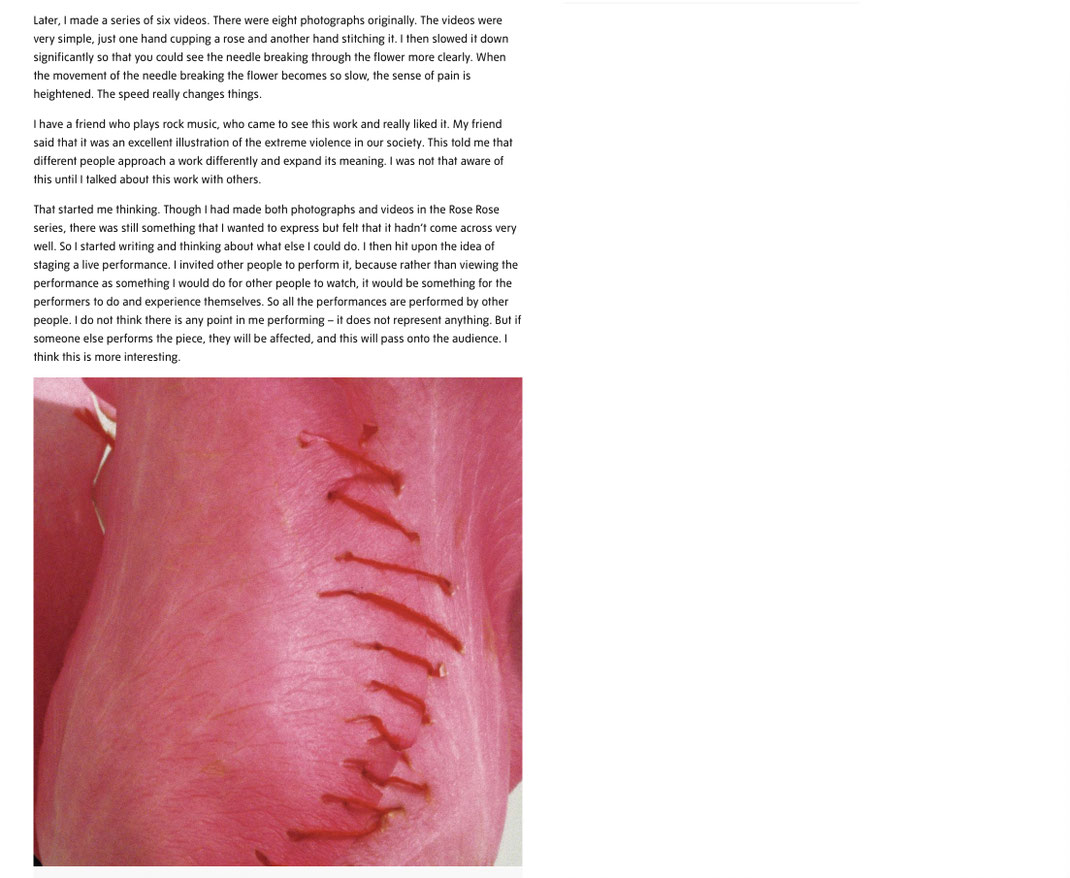
The multiple photos, identical in each case, range from rose blossoms with their petals surgically stitched together to shots of a hyper-realistic sex doll in provocative poses.
The interplay of virginal and erotic elements bespeaks not only the dualistic nature of marriage but the larger paradox of femininity itself—at once elevated and degraded, purified and reviled, worshiped and subjugated.
A desire to escape the low and mundane seems to animate the departed figures in the photo installation I Want to Fly (2006-08).
To create the effect, Lin asked individuals to jump energetically while she photographed them from a low angle.
She then juxtaposed the cutout shape of each leaping figure, seemingly stitched or bandaged into place, against street scenes or construction-site images.
Some of the resulting pictures were mounted on suspended heart-shaped hand mirrors with wings, reinforcing the Baudelairean impetus to transcend self-reflection and pass n’importe où hors de ce monde (“anywhere out of this world”).
But there is clearly a downside to this wish.
To be ourselves, Lin’s missing persons imply, we must be free to define our own goals and fulfill our own nature.
Yet how can we, as human beings, fulfill ourselves except through connections, however onerous?
Even the smallest social unit, the couple, is subject to this dilemma.
For Never Apart (2009), Lin cut one figure out of each of several bride-and-groom photos and inserted them on opposing inner surfaces of rectangular compacts. Here, to be “open” means to be apart; the spouses are together—or almost so—only in the darkness of the closed case.
The 300-unit "I Want to be with You Forever" (2008-09) separates the marital pairs even more poignantly—one (almost always the man) embracing a partner-shaped void on the surface of a toy bed, while the absent mate hovers perpetually on the canopy overhead.
At the heart of the human condition, Lin suggests, lies an unfulfilled longing—a quest for genuine connection that inevitably, given the self-contradictions of human nature, translates into a vacillation between solitude and ritualized but imperfect union.
Beyond the romantic pair lies the family and society—equally necessary, equally encumbering, equally flawed. Lin’s most complex examination of this problem, the series “Nobody Knows I Was There, Nobody Knows I Was Not There,” so far encompasses three related bodies of work.
Private Memories (2009) is a traditional Chinese medicine chest with 90 drawers, each now devoted not to herbs or other medicinal substances but to extended-family photographs from roughly the last 100 years.
The yellowing images—depicting parents, grandparents, distant aunts, uncles, cousins, etc.—lie tenderly on beds of cotton, implying a respect for “precious” blood ties and the collective past. Yet every figure has been literally defaced—its visage cut out, leaving a hole.
This act of intimate vandalism, rendering the individuals anonymous, is Lin’s mildly shocking way of reminding us that families are constituted largely of roles that persist across time and historical circumstance, regardless of who plays the parts in turn.
Each drawer contains, in effect, a treatment for illusion. Just as medicine works in like fashion on every person, no matter who they are, we all serve as father, mother, brother, etc., in fundamentally similar ways. In the end, only those conventions remain; no potion can cure death or prevent the annihilation of personal memory.
CCTV News (2008) explores public roles from the same disabused perspective. Small metal boxes, their lids emblazoned with multiple Coca-Cola logos, bear stitched-on photos of organized group events—meetings, concerts, calisthenics, political rallies—with the myriad participants clearly shown but the leader cut out, leaving only a ghostly void. This evokes not only the shadowy nature of much official leadership but also the loss of self that is entailed, for followers and directors alike, once strict social organization comes into play.
The news, we are reminded, is often a montage of such scenes, conceptually disjunctive and recounted in an eerily dispassionate “professional” manner, while Coke and other mass-market products reign increasingly over the distribution of vital information.
Such, too, is the import of Public Memories (2011), the third component of “Nobody Knows I was there ,Nobody know I was not there . . . ,” in which a wide variety of photographic scenes from the past and present (including dance presentations, group portraits, award ceremonies, airplane boardings and exits, key movie moments, and colloquies ranging from intimate to diplomatic) are cast in bright monochrome colors, with selected faces and figures stitched over.
The sewing creates a partial erasure of that character on the recto side and a thread silhouette on the blank verso. The simple device makes a telling point: in groups and daily situations, the self is somewhat eradicated; yet without these interactions, one feels meaningless and adrift.
The vulnerability of that self is most movingly represented by the stitched-together blossoms highlighted in the photographic suite " Rose Rose" (2008-09).
The flowers, traditionally associated with women and romance, are shown singly in close-up or as bouquets jammed into garments and shoes, the long green stems evoking lower bodies and legs. The tender pink petals, meanwhile, recall skin—provocative when bursting from openings in the clothes, delicate when seen at close range knit together with sutures. Opening flowers often represent nubile women and their vaginas, while wilting flowers stand for the transience of life. But Lin offers something new: blossoms sewn together as though in the hope of recovery, thus emblemizing the wounds that flesh and soul alike are heir to.
In the installation Insecure Security (2011)—the title seems to summarize Lin’s take on human relationships—real threads, as red and attenuated as blood vessels, hold together pieces of white clothing or fill the interiors of ornate white slippers. The very ties that unite us, it seems, may also limit our growth.
That idea is explored in great depth and detail in the ongoing project Color of Memory (2010-). The end product may be a series of paintings and wall texts, but the essence of this work resides in its process. Lin asks various people to tell her three things: their single most painful memory, the object they associate with it, and the color that the memory brings to mind. She then makes a deliberately crude monochrome painting of the object in the color specified, and exhibits it with a text transcribing the Q&A between subject and artist. Everything about the project is memorable—the candor of the participants, the emotional rawness of their recollections, the aptness of their object and color choices, the dreamlike power of Lin’s renderings.
The stories are heartbreaking: a woman who loses her three-year-old daughter forever at a shopping mall; a medical student who watches a patient die on the operating table under the hands of a skilled surgeon; a wife who receives a letter from her husband’s pregnant girlfriend, and responds by terminating her own pregnancy and her marriage. In Lin’s world, we are all damaged flowers—holding ourselves together by force of will, hoping to transcend grief, beautiful in our fragile persistence.
In the recent performance installation I (2011), the artist invited participants to sit with books and patiently cover all the text, line by line, with white correction tape, leaving only the punctuation and the word “I.” This “correction,” an erasure of all that describes, defines, qualifies, enriches, and contextualizes the self, results in hauntingly minimal volumes. The pages are as white as marble slabs; language is reduced to the cogito (the “I” of Descartes’s “I think; therefore I am”) and a few vestiges (periods, commas, quotation marks, etc.) of its former situation, its contingency, in a vanished physical and conceptual milieu.
In existentialist terms, the world is composed entirely of the “I” and the “not-I,” pure consciousness and brute things, the self and the Other. Yet there is, and can be, no pure intellection; every thought is a thought about something. And the most disturbing, most challenging something is another mind.
The loss of family and friends, imprisonment, illness, political repression—all these and more tend to isolate us (a fact that makes this work exceptionally effective across cultures). But always we find around us the lingering signs of other subjectivities, other judgments and desires, other plans. So long as we live, the “I” will ceaselessly wrangle with history and the conflicting wishes of others. The push-pull of interacting wills—sometimes contending, sometimes cooperating—continues without pause, until death brings obliteration, a perfect nothingness.
Lin Jingjing’s contribution to contemporary Chinese art is thus two-fold. She couples a focus on individual experience (in what has for centuries been a collectivist culture) with art-making of unassuming skill. The amalgam generates a distinct form of beauty—existentialism melded with subdued artistry, and permeated with simple human care. In short, Lin’s vision is compassionate, transcultural, and mature.
(Richard Vine : Managing Editor of "Art in America" Magazine)
美之所在:林菁菁的艺术
—Richard Vine
“我”在“空了的空间里静默着,孤独地乞求解释
---林菁菁
放大的面孔、惊世骇俗的行为表演、巨大的雕塑、诡异的场景摄影与匪夷所思的影像作品,中国当代艺术就这样借由离奇的创作手段为国内外所知。
这些大胆的、让任何文化都为之一颤的美学实践,在这块曾经浸润在静默诗意与细腻丹青的国度异常活跃。后毛泽东时代的改革开放政策得以让两种不同形态的视觉修辞——文革宣传画和西式广告,融合于后开放时代漫不经心的中国美术。
伴随着经济增长和社会开放,上世纪九十年代兴起的中国前卫艺术家,对这片土地所经历的政治创伤及其原由知之甚少。那些应接不暇的变化和社会、物质与心理的异位才是他们急切需要面对的问题,由此产生的艺术实践也是丰富多样、切合他们个体经验的。
尤其是女性艺术家,她们受到西方女性主义的影响,但由于对群体创作与理论教条保持着警惕,她们的创作多以私密空间和个人焦虑为母题。
林菁菁,毕业于中央美术学院研究生院,用不同于伤感与性的表述方式参与到女性主义话语当中。
她的绘画、经过改造后的现成品装置,将那些极其痛苦的题材:死亡、失去、孤独与背叛,表述得非常精致、而且有节制,甚至带着一丝幽默。
作品《物语》 (2006-09)由多件白色的衣裙组成,上面用蕾丝花边和各式各样的棉花球做装饰,这些丝质衣裙展示在画面中心,作品用纵横平铺的圆形小图片为背景。
其中一些非常纯真、非常女性化,一些则明显设计得让人联想到女性生殖器官。
这些小图片,大小统一,有的是缝合的玫瑰花骨朵,有的是质感真实的性玩偶摆出的挑逗姿态;贞洁与色情的相互作用影射了婚姻中的二元性,同时更大程度上体现了女性自身所蕴涵的矛盾与复杂:升华与贬值、纯洁与玷污、被追随与被征服。
在照片装置作品《我要去远飞》(2006-2008)当中,一股想逃脱世俗的欲望似乎控制着照片装置作品中那些展开双臂的人形。
照片的拍摄过程中,林菁菁要求被拍摄的个体充满活力地一跃,同时在较低的拍摄角度,抓下跃起的一瞬间。然后,将这些个体跳跃的瞬间并置在一起,用缝合的方式将它们固定在有街道和建筑工地背景前面。
这个系列,也有部分图片缝合在悬起的心型镜子上,再配以翅膀,给人以波德莱尔式的自我升华以及穿越这个世界之外的任何地方的诗意。
显然地,这些作品有其悲观的一面。
那些被镂空的人型,隐含着一层意味:为了做好我们自己,我们必须能自由定义自己的目标与自我意愿的满足。
然而作为人类,除了通过周边各种关联性来实现自我满足外,还有什么更好的途径呢?
就连夫妻这种最小的社会单元也面临这样的难题。
在《永不分离》(2009)中,林菁菁将情人的亲密照中的一方镂空剪下,并把它装裱在一个小长方型镜盒里与被镂空的照片遥相呼印。
在这里“开放”意味着分离,这些情侣只会在盒子关闭之后的黑暗中,才能得以相聚。
《我要永远和你在一起》(2008-09)用一种更有深刻意味的方式将三百对夫妻们分开:其中一方,以男性为主,在袖珍玩具床上拥抱被镂空的妻子形状,而妻子的图片则永久地悬于袖珍床的顶棚上。
林菁菁提出的人类境遇的核心是一种永远无法被满足的渴求。
人们渴求真诚关联性的同时又避免不了撞见人性中的自我矛盾,作品中这些夫妻被叙述为一种在独立与仪式化之间摇摆不定,形成不完美的结合。
家庭与社会提供比浪漫情侣更深层次更丰富的思考维度,它们具有同样重要的存在必要性、同时也都充满瑕疵、步履为艰。
《没有人知道我在那,没有人知道我不在那》是林菁菁对家庭与社会这一复杂问题的一次审视,这个系列目前由三件相互关联的作品组成:
《私人记忆》(2009)是一组由九十个抽屉组合而成的中国传统中药抽屉柜,里面装有黑白的家庭照片,横跨一百年的时间。
发黄的相纸上是艺术家自己的曾祖父母、父母、表亲、叔叔与侄子的照片。
这些照片被轻轻地搁在柔软的棉花上,显出血缘关系的珍贵和对集体记忆的尊重。
所有家庭照片中的人物面孔都被剪去,留下一个空洞。
通过这种小心翼翼的破坏行为,基于个体匿名状态的再创造,林菁菁用一种温和但却震撼的方式提醒我们:家庭是生活在各个历史时期的人们所组成,可能是一个人在不同辈分之间的角色转换。
每一个抽屉内所承载的内容可以看作是对一个幻想所下的药方。
就如药对不同的人有着同样的效果,无论照片中的人物是谁,我们都基本承载着彼此相似的多种角色,父亲、母亲、兄弟等等。 最终,只有这些角色的形骸留下,没有什么能治愈死亡,或阻隔个人记忆的泯灭。
作品《新闻记忆》(2008)用同样的角度对公共人物角色进行审视。
在多个印满了可口可乐商标的金属盒子上出现多个正式场面,有会议、音乐会、运动会、政治集会等场面。
在密密麻麻人群中有一个核心人物的形象被镂空,留下幽灵般的空洞。
这件作品以一种警示的视角来打开我们对于“公共人物”的理解。
作品中的被镂空的核心人物形象不仅暗示了公众领袖的虚无,同时影射了无论是从众还是领袖,一旦进入到严格的组织形态中,内心自我即迷失。
作品也提示我们习以为常的新闻节目将各种事件堆砌在一起,以一种职业化冷静姿态播报出来的时候,无形中已经被批量生产的商品,例如可口可乐,越来越多地将真正重要信息传播所掩盖。
作为《没有人知道我在那,没有人知道我不在那》系列的第三部分,《公共记忆》(2011)也有类似的意味。该作品由大量的摄影场景组成,从舞蹈表演、合影、颁奖仪式、登机和出仓到经典电影镜头等组成,场景的选取从公众到私密。
艺术家用明亮的单色调覆盖画面,有的照片中的人物面孔被缝补过。
缝补让人物在正面看上去模糊了,而在反面呈现一个线勾勒的轮廓。
这样简单的设计展开了作品的内容:在日常或群体的互动过程中,自我基本上是被抹杀的,然而没有了这些互动关系,人们又会觉得没有意义或随波逐流。
自我的脆弱本质在《玫瑰玫瑰》(2008-09)这件以摄影为媒介的系列中得到了非常生动的体现。
作品中被缝合的玫瑰有的单独一朵,有的则整把挤在礼服或者鞋子里面,长长的绿色花枝让人联想到下半身和腿。
柔软的粉色花苞让人联想到肌肤,在衣服中含苞待放,挑起欲望。
走近细看才能注意到每朵花苞上面的缝合口。
玫瑰是女性和爱情的典型象征物,盛放的玫瑰通常代表富有性感的女性和她们的性器官,枯萎的玫瑰则被喻作生命的短暂。
林菁菁则给出一个新的比喻:被缝合的花苞虽然预示着康复,同时也象征着肉体和精神上不可抹去的痕迹。
装置作品《安全的不安》 (2011)的标题看似在总结林菁菁关于人与人之间关系的理解:红线上渐弱的红色就像血管,将白色的布连在一起或者填满装饰华丽的白拖鞋。那些看起来维系我们之间的线,也可能成为限制我们成长的牵绊。
在《记忆的颜色》(2010-)中,林菁菁对这个概念做了细致深入的探索。
林菁菁让人们回答她三个问题:自己最痛苦的记忆,与这段记忆相连的物件,可以描述这段记忆的颜色。
然后她用述说者描述的颜色绘制与述说者记忆相联系的物件,展出绘画作品的时候同时配有对话的文字。
这个项目仍未结束,最终的作品形态可能是一系列绘画和墙上的文字,但是这件作品的关键在于它的过程。
参与者的率真,回朔记忆期间所灌注的感情经验,以及他们所选物品和颜色,与林菁菁的梦幻般的创作手法结合使《记忆的颜色》成为一件耐人寻味的作品。
有的故事很让人心碎:在购物中心丢失自己三岁女儿的妈妈;一位医学学生看着一位患者死在一个医术高超的医生的手术台上;一位已有身孕的妻子收到她丈夫已经怀孕的另一位女友的信,她以终止自己的妊娠与这段婚姻做出答复。
在林菁菁的世界中,我们都是受伤的花,以强大的内心力量缝合自己的伤口,脆弱的坚持格外美丽。
在最新的行为装置《我》(2011)中,艺术家邀请参与者坐下来将书上的句子一行行用修正带覆盖,只留下标点符号和“我”字。这个“修正”过程抹去了所有描写、定义、资格、润色以及上下文关系。
剩下的是幽灵一般的无字书,书面色彩如汉白玉般洁白,语言只剩下“我思故我在”,以及少量的关于抹去之前的状态、偶然性的痕迹(逗号、句号和引号等等),这些痕迹存在于消失殆尽的物理和观念当中。
用存在主义的话说,世界完全有“我”和“非我”组成,纯意识和最原始的,自己和他者。然而没有,也不可能有纯粹的意识活动;每一次思考都是对“某种东西”的一种思想。最令人不安也是最具挑战性的这种“东西”,是另一个人的思想。
失去家庭和朋友、监禁、疾病、政治镇压,这些东西会割裂/孤立我们(正是这个事实让她的作品在不同文化中都能引起广泛的共鸣)。
但是经常会在我们周围发现其他的主观性、判断和欲望在游离。在我们有生之年,“我”会不停地与历史、相冲突的意愿以及生命中的其它相纠缠。相互作用的意愿,持续不停滴时而相斥,时而合作,直到死亡带来最后的审判将所有定格。
这样,林菁菁对中国当代艺术的贡献在两个方面:她聚焦于个人经验(在一个集体主义盛行几个世纪的文化氛围当中),以并不张扬的艺术创作手法。这两方面糅合出一种独特的美感-存在主义与内敛的艺术创造结合,渗入简单的人文关照。
简而言之,林菁菁的艺术是富有同情心的、跨文化的和成熟的。
(本文作者 Richard Vine 系《艺术在美国》杂志主编)
Public privacy: Lin jingjing's works
Gu Zhen Qing
Public privacy usually refers to individual privacy and privacy rights in public settings. Privacy refers to concealed, non-public affairs. Individual privacy touches on individual rights and an individual’s secrets, things that have nothing to do with other people. Individual information, private affairs and the individual realm are things that the individual is unwilling to reveal to others, or to have others intervene in; these are privacy rights. In today’s globalized, networked world, individual privacy and privacy rights are in danger. A side effect of technological progress has been that the public sphere is no longer limited to physical public spaces. Public information platforms, urban surveillance systems, internet monitoring, candid street photography, human flesh search engines and hacker attacks have all become methods, both positive and negative, for breaking down the boundaries of privacy. This has made individual privacy increasingly transparent, something that the public can give or take away, something that can be revealed at any time.
With her feminine sensitivity, Lin Jingjing has found within her own childhood an anxiety derived from individual memories and privacy. She has become aware of individual privacy’s inability to resist the public world. When individual privacy encounters the public setting, it faces the danger of being invaded or swallowed up at any moment. As an artist Lin Jingjing’s societal role is to create artworks, present them and reveal their secret import. The artistic exhibition space is a fully exposed stage, a completely public setting that every artist must face. For this reason, the weakness or danger of individual privacy alluded to by the concept of public privacy has become the focus of Lin’s insight into the relationship between the individual and society.
In November 2009, the Song Zhuang Art Museum exhibited Lin’s 2007-2009 installation series I want to be with You Forever and Never Apart. These works used hundreds of wedding photographs taken from wedding photography studios and the artist’s friends as social survey visual research material. Lin’s photographic alteration techniques were low-tech, manual, even crudely interventionist. In each photograph, she forcefully removed one of the people from each of these intimate spaces and placed them into different spaces. In I want to be with You Forever, Lin used miniature toy wedding beds. These identical European-style white wire-mesh wedding beds bore obvious traits of the consumerist culture inherent to China’s social transformation. She took the five inch wedding photos, with one person removed, and sewed them into the fine wire mesh of the toy bed, while the other person from the photo was sewn alone onto the canopy of the bed, directly above its cutout silhouette. Since the two images were aligned, when the viewer looked down from above, the two subjects of the wedding photograph were still together, albeit separated by a fine wire mesh. In Never Apart, Lin used cheap compact mirrors. The external casing of the compact mirror is a joyful image of a peony flower over a red background, and the edges are lined with gold geometric markings. The brides and grooms of the wedding photos have been placed on opposing sides of the mirrors in their original positions. With the mirrors open to 90 or 100 degree angles, it appears as if the brides and grooms have been reunited in their reflections. Lin uses the dismantlement of these wedding photos to express her skeptical attitude on the union and disunion of male and female relationships in the contemporary marriage. The use of hundreds of tiny wedding photographs of unknown couples represents a grand narrative of size and scale. Another trait of public privacy emerges through the constant probing of Lin Jingjing’s artistic imagery. These countless private photographs of men and women, owing to their repetitive poses, stiff postures and identical expressions, have been wiped of individuality, and for this reason it does not amount to the exposure or revelation of any particular individual identities. Public privacy is also a process of the formatting of privacy. If the private subjective is not brazen, and the public does not track down individual cases, then the monotone individual privacy is submerged within the planned and designed social realm. Though this individual privacy repeatedly emerges in the public setting, it blurs the public gaze to the point where it is no longer seen.
In her early years, Lin Jinjing concentrated her efforts on painting, creating oil paintings of skirts and signs with a freehand technique. As she honed her artistic practices, Lin,as a woman artist, she often experimented with inserting once tightly held private details of life into her works, presenting them to public society through metaphor and symbolism. In fact, within the artist’s experiences, not only the body’s characteristics, private life and private habits but even private diary entries, photo albums and communications, all of these things that belong to the realm of privacy rights, become a series of convenient and rich resources that the contemporary artistic spirit cannot ignore. If self-concealment is the right of the individual, then self-exposure and self-expression are also individual rights. For this reason, Lin has been trying to break the taboos of privacy to look upon the self and the world truthfully and objectively. She is bent on forcing certain individual privacies to encounter the public sphere and become public privacies.
From 2001-2002, Lin engaged in a year-long photographic diary series entitled My 365 Days. She placed the hairs that fell out of her head each day into a bowl and took a photograph as documentation. What appeared to be a random stream of photographs was actually marked by temporal qualities, laying bare a woman artist’s sense of helplessness and emotion in the face of her passing youth. The lack of emotion found in the simplicity and unity of the image style evokes traditional aesthetic imagery of the unforgiving march of time. This exposure of privacy and her cool attitude towards the brutal reality of one’s fading youth are things that come from Lin’s heart. This led her to a deeper understanding of more contemporary art concepts and opened up new means of expression.
Afterwards, Lin Jingjing’s painting language grew more open. Her Diptych series of 2005-2007 recreated public images that were popular during the Cultural Revolution, and brought them into the imagescape of everyday life as flourishing touches in the foregrounds or backgrounds of figure paintings. This individualized reproduction or transplantation of public images from history is perhaps linked the artist’s personal memories. With their lack of defining traits and their Cultural Revolution-era clothing, the figures become striking collective memories. It was precisely this call to remembrance and cultural introspection that brought Lin’s diptychs beyond expressive forms and towards the conceptual.
The 2007-2008 photographic series I Want to Fly was an effort to bring her individual creations on the track to systemization. It was as if she directed, shot and produced a group performance art piece. She repeatedly set up a camera and asked the young people around her to jump in place in front of buildings marked for demolition or construction sites. Each photograph presented one person. The low camera angle placed the people in the sky. She then cut out each person from the resulting black and white photograph and attached them and the separate backgrounds onto opposing book pages made of cotton. The soft cotton sticks out from the edges of the cutout pictures, creating a sense of floating people within the empty silhouettes. Among the different poses, some of the people appeared to be flapping their arms like birds. Lin placed the hollowed-out photographs on the right side of the cotton page, with the figures on the left side. On the left, the leaping figures removed from their surroundings floated in solitude above the cotton background, like symbols removed from reality, metaphysically floating, carrying Lin’s cultural idealist yearning to escape the fetters of the world and fly off into the distance. Flight is the realm that Lin Jinjing has always sought in life. In having normal people open their arms and jump in place, she is actually trying to let them escape their increasingly mechanized jobs and trivial everyday lives to experience a moment of transcendence. Those flying white silhouettes are suggestive blank spaces which the viewer can interpret as multitudinous avatars of the artist or can project themselves into, to imagine a moment of flight. On the surface, Lin’s projective empathetic method appears to be an expression of the generosity that is unique to female Chinese intellectuals, but in fact, it is the artist’s systematic attempt to create individual style and imagery in the language of photographic installation.
Lin Jingjing’s empathetic method is even applied to inanimate objects. In the Rose, Rosephotographic series, she uses red string to stitch the rose petals together on the bud, and presents the intricate stitches and wounds on the flower petals through massive, high-resolution subjective pictures. The pain alluded to in these vivid details is frightening. The artist uses a subtle, intentional harming of beautiful objects to allude to mankind’s violent destruction and exploitation of nature. Her Dress - Rose series forces roses into women’s clothing, further anthropomorphizing roses. Her 2006-2011 Dress series is an effort to use beautifully exquisite wedding dresses and silk gowns as visual mixed media materials. The minutest details of those beautifully laced garments are laid out to create desolate imagery, like a series of bodies emptied of all spirit. The coldly beautiful images are alluring, yet viewers dare not look too closely.
Privacy rights are a product of modernity. They have been broadly affirmed by civil society as god given human rights. It was because of this that they were enshrined in legal shields and moral screens. But the Talmud said long ago that there are three things man can never keep private: a cough, poverty and love. Under globalization, privacy is finding it increasingly difficult to hide from the increasing pervasiveness of mass culture and the eyeball economy. The screen of privacy is often warped and twisted, worn thin and brittle. For Lin Jingjing, once privacy can no longer conceal that which the artist most wishes to conceal, then revealing private memories, private emotions and independent awareness to the public become her best methods of protection. For this reason, public privacy is no longer a passive concealment but an active revelation and sharing. Public privacy is a way of replacing private privacy, and solution to media’s penetration of the deepest levels of privacy. When some people’s secrets can be shared and turned into public information, public affairs and the public domain, then the private privacy becomes an unspoken open secret. When many people see the telling of individual secrets as a means of relieving stress, then below this surface of sharism, each person will find better concealment for a deeper level of privacy.
In 2008-2009, Lin Jingjing further probed the collective and private memories in her individual experience, creating the two photographic installation series Private Memories and News Memoriesunder the theme Nobody Knows I was There, Nobody Knows I was Not There. Ambiguous and equivocal definitions of public privacy are controversial, but Lin finds clear, dualist values judgments to be useless, and feels that more ambiguous approaches can reach closer to the truth of public privacy. Her passion for paradoxes grows ever stronger. She has incorporated highly perceptive paradoxical thinking into her methodology, infusing her artworks with a personalized sense of form. In 2010-2011, she pushed this paradoxical theme a step further with her Public Memoriesseries of oil paintings.
Private Memories is actually a single photographic installation, a collage of photographs collected from her relatives that span the breadth of the 20th century. Lin Jingjing used an old-style Chinese medicine chest with 90 drawers to present these private photographs of various sizes, lining each drawer cavity with cotton and placing only one photograph in each. Some of these dusty, yellowing photographs are studio family portraits, some are individual portraits, some are passport photos and others are commemorative group portraits. They come in many forms, but all of the people in them are related to Lin Jingjing in some way. Lin views these photos as both a visual family tree and as a precious collection of materials regarding her own life. Drawing from her thinking on public privacy, she has gouged out the faces of all the people in the photographs. As a result, each of the figures in these pictures has a gaping hole in a key place. With the faces removed, the uniquely private properties of these images have disappeared. What remains is lifeless clothing, furniture, buildings and scenes. The figures may be empty shells, but viewers fill them in with the artist’s own portrait. After all, they are all Lin’s relatives, so they must look like her. Genetic references turn all of these photographs into Lin’s avatars. It is as if Lin has used the cycle of life to lead the viewers into experiencing the trying times and glorious moments of the last century. Her arbitrary method of concealing her family’s privacy led to a unique image expression form, turning the artist into a chameleon who can pass through history and life with the utmost of ease. Perhaps it is this dreamlike, indefinite quality of her imagery that leads her to exclaim “nobody knows I was there, nobody knows I was not there.”
Lin Jingjing’s News Memories series uses images derived from CCTV news reports. Her selection criterion was that the image must contain a central figure as well as a crowd. As a result, most of the images are related to Chines official political gatherings and coverage of political life. One after another ritualized collective event is brimming with ideological atmosphere. Lin has removed the face of the core figure in each image, and then stitched each image – minus the face – onto a porous metal box, which is then covered with a lid marked with the Coca-Cola logo, in an allusion to the conflict between the right-leaning consumer society in the background and the left-leaning ideological imagery at the center. In the faceless figure, there exists the logical paradox of simultaneous presence and absence. The true visage of that core figure is already absent, becoming a public privacy intentionally created by the artist. Though the specific individual has been concealed by the artist through subjective methods, as long as the profile is there, he is still the core of the image. When the different profiles are placed together, they take on shared properties, becoming what is apparently an omnipresent, headless big brother who appears in different public settings with different poses and bearings. Lin’s intention is to use this to examine the collective unconsciousness of the public memory. The result of omission is often public approval. It doesn’t matter who that core figure is. What matters is that there must be such a core figure in every crowd.
The 2010-2011 Color of Memory series is a work that Lin Jinjing derived directly from individual secrets. She devised three questions regarding pain to ask of friends around her willing to share their secrets: 1, what is your most painful memory; 2, what object is connected to that most painful memory; and 3, what color best describes that most painful memory? Lin then creates a painting according to those answers, giving each painting a certain color and certain object. The key element of this artwork is the process of transforming individual secrets into public privacy. By placing concrete, everyday objects together with abstract colors, the artist has turned private memories into metaphor-rich symbols. These visual symbols cast doubt on and ridicule the increasingly superficial symbolic cognitive mode that is created by public privacy. Individual secrets have nothing to do with public or group benefit, but when private secrets are turned into public privacy, they become inextricably linked to public benefit. Perhaps this is Lin Jingjing’s thinking regarding privacy.
公共隐私:林菁菁的影像记忆
顾振清
公共隐私一般指公共场合的个人隐私和个人隐私权。隐私就是隐蔽、不公开的私事。个人隐私涉及个人利益、个人生活的秘密,和别人无关。而个人信息、个人私事、 个人领域不愿也不便他人知道、干涉和入侵的权利,就是隐私权。这种个人隐私和隐私权在当下全球化、网络化的全媒体时代,已经变得岌岌可危。作为科技进步的另类结果,公共场合已经不限于公共场所、公共信息平台,全城摄像监控系统、网管、随手拍、人肉搜索和黑客入侵已经成为公众穿透、干涉个人隐私壁垒的正反两种手段,这一切让个人隐私日益透明化,成为一种公众可以予取予夺、实时披露的社会现实。
出于女性的敏感,林菁菁从自身成长中领略到一种来自个人记忆和隐私的焦虑。她意识到个人隐私在公共世界中不可对抗性。个人隐私一旦遭遇公共场合,随时就有被入侵、被蚕食的隐忧。而林菁菁的艺术家身份,又决定了她从事的创作作品、展示作品、披露作品隐秘内涵的社会行为。艺术展览空间又是艺术家不得不面对的一种全无遮蔽的环形剧场、一 种彻头彻尾的公共场合。于是,公共隐私所预示的个人隐私权的脆弱感和高风险,就成了林菁菁洞察的个人与社会关系的焦点。
林菁菁2009年11月宋庄美术馆个展中展出了2007-2009年系列装置《我要永远和你在一起》和《永不分离》,作品使用了艺术家从朋友处和婚纱影楼随机征集来的数百张婚纱照样片,作为一种社会调查式的影像素材。林菁菁的影像改造手段是低科技的、手工的、甚至是粗暴干 预式的。她只是用利器,把这些婚纱照上亲密无间的男女主角中的一个形象整个裁出、挖走,置于另一个空间。在《我要永远和你在一起》中,林菁菁借用了迷你型 的玩具婚床。这些统一欧陆风情制式的白色铁丝制婚床具有浓郁的中国转型期社会的消费文化特征。她把含有镂空形象的5吋婚纱照片缝合、固定在格栅密致的丝网式床 榻之上,主人公的缠绵对象是一个被挖空的剪影。而被挖出的另一主人公形象则缝合、固定在穹形床顶之上,形只影单。由于图像位置的对应关系,在观众俯视的角 度下,被强行分离的一对婚纱照主角形象又恰巧契合在一起,只是隔了一层密致的丝网格栅。在《永不分离》中,林菁菁则采用了一批廉价的便携式双面补妆镜盒。镜盒外壳为喜庆的大红底牡丹花图案,镜面框架则为艳俗的金边几何纹饰。被分置的婚纱照男女主角按原来的组合位置各据一个镜面。由于镜盒处于90度至100 度角打开状态,所以,面对观众,男女主角又在彼此映照的镜像中重逢、复合,虚拟出两个的近似破镜重圆的假象。林菁菁利用婚纱照影像的拆解,挑明了对当代婚 姻所牵连的种种分分合合的男女关系的一种质疑态度。由于她征用数以百计的未知男女微观化的婚纱照图像,构成装置作品集合化、规模化展示的宏大叙事。公共隐私的另一个特征就在林菁菁艺术语境的不断拷问中浮现出来。无数男女的隐私图像,由于姿态划一、动势僵硬、表情重复,反而屏蔽了个性,无法构成针对特定个人信息 的曝光和披露。公共隐私也是一种隐私格式化的过程。如果隐私主体个性不张扬,公众又不追究个案,千篇一律化的个人隐私也就会淹没在被设计、被规划的社会规 范之中。即便这类个人隐私在公众场合反复出现,也会让公众焦点模糊,熟视无睹。
林菁菁早年执着于绘画,以写意手法画了一些裙子和符号的油画。随着自身艺术实践的历练,作为一个女艺术家,她却常常尝试把以前不愿让他人知道的个人生活隐私纳入作品之中,以暗喻、象征的方式公开表达给公众社 会。其实,艺术家的个人经验之中,不但身体特征、私生活和私人习惯,而且个人日记、照相薄、通信等,所有这些原本属于自己隐私权的内容,却是建构当代艺术 精神不容回避的一座座最便捷、真切的资源富矿。既然自我遮蔽的隐私权是一种个人权利,那么,自我曝光、直白表达也是一种个人权利。于是,林菁菁尝试打破隐 私禁忌,真实客观地看待自身、看待世界。她执意要让某种个人隐私遭遇公共场合,成为公共隐私。
2001-2002年,林菁菁实施了一个为期一年的日记体摄影作品《我的365天》,她每天把掉落的头发放在一个空碗里,再拍一张照片作为记录。看似流水 帐的集合摄影却有时间记录的特性,完全清空一个女性艺术家对韶华易逝的无奈与感怀。简约、整一的图像风格传递出的零度情感,转述了一种落花有意、流水无情 的传统美学意境。这种晾晒隐私、坦然面对自己青春远去之严酷现实的气度,来自林菁菁心中的内驱力。这也促使她领略更多当代艺术理念,开拓更多表述方式。
后来,林菁菁的绘画语言也变得更为开放。她的2005-2007年的“双联画系列”再现了文革时期流行的一些公共图像,并把这些图像融入到日常生活的图景 之中,成为人物前景或背景中的一些点缀。历史上的公共图像的个性化再现与移植,也许跟艺术家的私人记忆有关。由于画中人物没有具体相貌,她们具有文革时期 衣着特征就构成一种鲜明的集体记忆。正是这种记忆的唤醒和文化的反省,使林菁菁的双联画越过表现主义样式,指向某种观念。
2007-2008年的摄影装置系列《我要去远飞》是林菁菁把个人创作纳入系统化轨道的一种努力。她几乎是导演了一批群众演员的行为表演,并进行现场拍 摄、后期制作。她不断设定相机机位,即随机邀请一些身边的年轻朋友在待拆迁建筑、地盘工地之前起跳。一张照片表现一个人。由于相机机位较低,跳跃的人被定 格在空中。林菁菁再把每张黑白照片上的人物形象按轮廓线抠挖下来,分别缝合在一本摊开的用棉花制作的白色书本之上。棉花质地柔软,于是就在照片被挖空的剪 影中膨胀鼓起,形成一个浮凸、飘忽而空洞的人形。由于人形姿态各异,有些人形居然构成了一种鸟儿飞翔的姿态。林菁菁把这种镂空图像置于棉花书本的右手页 面,而挖下来的人物则缝合于左手。左手边,那一个个失去了具体环境的跳跃人物孤悬在棉花纯白的背景之上,犹如一种脱离实际、形而上的飞翔符号,寄托了林菁 菁摆脱俗世羁绊、谋求远走高飞的文化理想主义追求。放飞自己一直是林菁菁孜孜以求的人生境界。她让普通人张开双臂、在现实生活中原地起跳,其实也是想让他 们脱离一下日益机械化的工作和一地鸡毛的日常生活,体验一刻超越现实的心境。那些飞翔的白色人形其实是一种填空暗示,观众可以将其理解为林菁菁的千百个化 身,也可以产生一种对号入座的心理投射,幻想一次自我的腾跃和飞翔。林菁菁推己及人的移情模式,表面上是中国知识女性一种泛爱主义的特有表现,实质上却是 艺术家在影像装置语言上营造个性风格、打造个人符号的一次系统尝试。
林菁菁的移情模式甚至还推己及物。在系列摄影《玫瑰•玫瑰》之中,她用红色丝线缝合玫瑰花朵,并以巨幅的、高清晰度的主观画面展示花瓣上精细的针脚和细微 的创伤。生动的细节所暗示的一丝疼痛感,让人心悸。艺术家利用对美好事物的极细微的人为伤害,暗喻了人类对自然环境的一贯暴力摧残和索取。她的《玫瑰物 语》系列则把一些女性衣物强加玫瑰花朵之上,让玫瑰的形象进一步拟人化。2006-2011年的《物语》系列,则是林菁菁把一件件精美婚纱、绸缎礼服当做 视觉元素和综合材料,直接制作平面装置作品的一种努力。那些精致的蕾丝花边的婚纱、礼服,以极为苍白的形象纤毫毕现地罗列在画面上,犹如一个个被抽空了精 神和灵魂的人物躯壳。略显凄美的图像却产生了一种令人唏嘘却又不忍细看的接受心理。
隐私权也是现代性的产物。它被作为天赋人权的一种权利而受到当代公民社会普遍肯定。由此,个人隐私才真正确立在法律的挡箭牌和道德的屏障之下。但是《犹太 法典》早就说过:人不能隐藏三种东西:咳嗽,贫穷,以及恋情。全球化条件下,私人隐私面对公众社会和眼球经济的无孔不入的挑战,越来越难以隐蔽。隐私权的 屏障时常被扭曲变形、变得薄如蝉翼。对林菁菁而言,一旦私人隐私不能屏蔽艺术家最想屏蔽的对象,那么,面对公众,公开私人记忆,披露私人情感,分享独立意 识,反倒成为她的一种自我保护的方式。因此,公共隐私不再是一种被动的隐藏,而是一种主动的打开、披露和分享。公共隐私成为私人隐私的一种替代方式,反而 变成全媒体时代各种深层隐私的解决方案。当一些个人隐私可以分享,成为公众共有的信息、事务和领域之时,这些私人隐私就成了公众心照不宣的公开化“隐 私”。 当许多人都把倾诉、公示部分个人隐私当作是自我减压的一种方式时候,其实在分享主义盛宴的表象之下,每个人另一些更深层次的隐私也就得以潜伏和隐蔽。
2008-2009年,林菁菁继续挖掘个人经验中的集体记忆和私人记忆,以“没有人知道我在那,没有人知道我不在那”为主题连续创作了《私人记忆》和《新闻记忆》两 个系列的影像装置作品。涉及公共隐私骑墙、模棱两可的定义,各种争论始终没有熄灭。但林菁菁偏偏觉得这种非此即彼、二元对立的价值判断不可取,而非此非 彼、否定之否定的思辩反倒接近公共隐私的真相。她越来越热衷于悖论,并把极具感性色彩的悖论思维贯注在方法论之中,从而赋予作品一种个人化的形式感。 2010-2011年,她又在这一悖论式的主题下推出一批《公共记忆》系列油画。
《私人记忆》其实是一个单一影像装置,它是艺术家回老家收集一批横跨1900年至2000年上一个世纪的自己血亲家族的老照片并置而成的作品。林菁菁用一 个拥有90个抽屉的老式中药柜来陈列这些大大小小私人照片,每个抽屉垫上白色棉花,只放一张旧照。这一张张尘封已久、有些泛黄的照片,或是照相馆家庭合 影,或是单人生活照,或是证件照,或是纪念性集体照,种类、样式丰富,但照片中的人物都是林菁菁的至亲和长辈。林菁菁既把这些照片看作影像家谱和家族志, 又把它们视作与自己生命有关的难得的材料。鉴于对公共隐私的思考,她把这些照片中所有人物的脸部全部挖去。于是,这些老照片上的人物都呈现出一个个至关重 要的漏洞和缺口。人脸被抽空,这些图像独特的隐私属性也就化为乌有。照片只剩下一些了无生气的衣着、家私、建筑和风景。人物只有空壳,但观众惯于用艺术家 自身的肖像去填空。毕竟,他们都是林菁菁的血亲,长相应该与林菁菁相似。遗传学上的依据,让每一张照片人物都变成了林菁菁的化身。林菁菁仿佛以生命轮回的 方式引导观众去体验上个世纪的艰难时世和峥嵘岁月。林菁菁屏蔽家族隐私的武断方法,反倒促成了一种独特图像表达形式,让艺术家自身转为百变精灵,在历史烟 云和现世红尘中任意穿越。也许,就是林菁菁这种难断非此即彼、难分梦里梦外的图像语境,让她生发出“没有人知道我在那,也没有人知道我不在那”的感慨。
林菁菁的《新闻记忆》系列则 从CCTV各种新闻截帧图像中选取。她选择的标准是:画面中必须既有核心人物、又有群众。于是,《新闻记忆》系列的大部分影像都是关于中国官方政治集会、 政治性群众生活的视觉文献,一个个极具仪式化特征的集体活动现场都洋溢着意识形态氛围。林菁菁把每个图片中作为构图焦点的画面核心人物挖掉,再把带缺口的 图像缝制在一个个多孔金属盒上,盒子则盖有带可口可乐商标的盖子。暗示了当下偏右的消费社会背景和偏左的现行意识形态图像的一种冲突。被挖去的核心人物同 样表露出一种存在与缺失的逻辑悖论。那个核心人物的真身已经缺失了,成为艺术家刻意制造的一个公共隐私。虽然具体的个人被艺术家的主观手段屏蔽了,但只要 他的影子还在那,还可以图像现场的中心。不同图像的影子集合在一起,就有了共性,仿佛有一个无处不在的带头大哥,以各种不同动势、姿态掌控着一个个不同的 公共场合。林菁菁企图借此反省公众记忆的集体无意识特性。缺省、省略的结果往往是公众的默认。图像中的核心人物具体是谁并不重要,重要的是人群中必须有这 样的核心人物。
2010-2011的《记忆的颜色》基本上是一件林菁菁直接发掘个人隐私而引发的作品。她设定了三个关于疼痛经验的问题来问身边愿意分享个人隐私的朋 友:1、什么是你最疼痛记忆?2、什么是你与此最疼痛记忆相关的物体?3、哪一种色彩可以用来描述此最疼痛记忆?然后,林菁菁再根据征集来的答案作画。赋 予每张画以特定的色彩、特定的物质对象。这个作品的要素其实就是把个人隐私转化为公共隐私的一个过程。由于艺术家把具体、日常的事物与抽象的色彩混搭,就 把每个个人的隐秘经验转变为一种充满隐喻的视觉符号。而林菁菁这种视觉符号,其实质疑并反讽了公共隐私所塑造的一种日渐肤浅的符号感知模式。个人隐私原本 与公共利益、群体利益无关,但个人隐私转化为公共隐私,就与公众利益息息相关。也许,这就是林菁菁关于隐私的悖论思考。