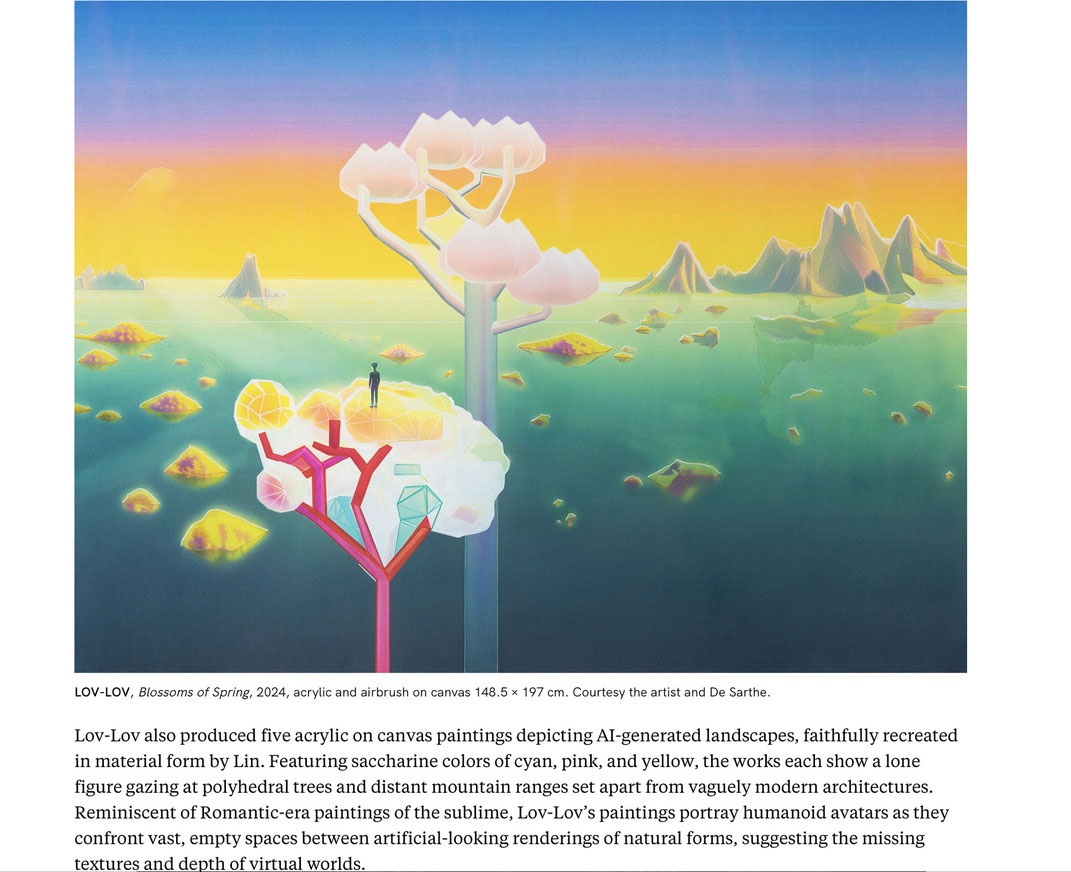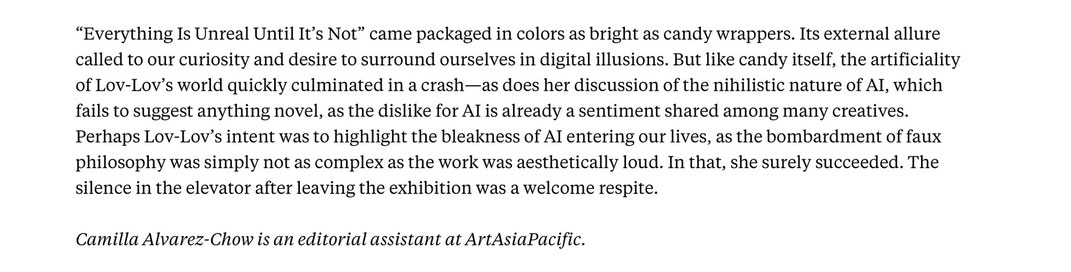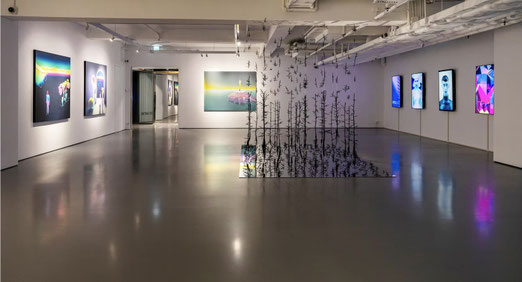
Lin Jingjing 林 菁菁
Lin Jingjing was born in Shanghai, China, and currently lives and works in New York.
She received her B.A. from the Department of Fine Arts at Fujian Normal University, pursued further studies at the Central Academy of Fine Arts, and earned her M.F.A. from the School of Visual Arts, New York.
Working across diverse cultural and social contexts, Lin has maintained a sustained interest in examining the assumptions that shape everyday reality. Over the past three decades, she has developed a multidisciplinary practice spanning installation, video, sound, animation, performance, sculpture, painting, photography, coding, and mixed media. Rather than being committed to a single medium, she selects forms and materials according to the specific needs of each project.
Many of her works begin with a seemingly minor observation: a phrase, a news story, a bureaucratic detail, a social phenomenon, or an aspect of daily life often taken for granted. Through extended processes of research, collection, and transformation, these fragments gradually evolve into complex and open-ended artistic projects.
Lin is particularly interested in how language shapes perception, how systems influence behavior, and how technological developments alter the ways individuals relate to the world around them. Drawing on formats such as archives, fictional narratives, institutional structures, surveys, instructional texts, and participatory frameworks, she frequently constructs situations that blur the boundaries between art and reality.
Humor plays an important role throughout her practice. When addressing serious subjects, she rarely relies on direct criticism. Instead, she often employs strategies of displacement, exaggeration, misinterpretation, role-playing, and subtle shifts in perspective, inviting viewers to reconsider their own position within familiar social and cultural frameworks.
Lin was profiled by TATE research Center: Asia, as part of their ongoing study of "Women Artist in Contemporary China" (with Artist original name: Lin Jing Jing) Lin's works have been exhibited in major public museums including the National Art Museum of Chile in Santiago(Chile), the Ivam in Valencia(Spain), the Kunstraum in Vienna(Austria), Galeria Herold in Bremen, Saint Mary’s University Art Museum in Halifax(Canada), the Leonard Pearlstein Gallery in Philadelphia, the Tikanoja Art Museum in Vaasa (Finland), the Long Museum in Shanghai(China), the Nanjing Museum Nanjing(China), Guangzhou Art museum in Guangzhou(China), the Du Land
Modern Art Museum in Shanghai (China) and Song Zhuang Art Museum in Beijing (China), Ljubljana Castle in Slovenia, etc.
Lin's work has been reviewed in major publications such as Asia Art Pacific, Artforum, Artnet News, AsiaArt, Southern Weekly, Kolaj magazine, Randian, China Daily, Luxuo, Hong Kong Economic Journal, South China Morning Post, etc.
Richard Vine, managing editor from Art in America wrote about her work:
“In paintings, altered objects and installations, she addresses some of the most wrenching themes imaginable—death, loss, loneliness, betrayal— with remarkable sophistication and restraint, even at times a touch of humor.
Lin's work has been sold by both Sotheby’s and Christie’s.
林菁菁出生于中国上海,现生活与工作于纽约。
她毕业于福建师范大学美术系,曾于中央美术学院进修,并获得纽约视觉艺术学院(School of Visual Arts)艺术硕士学位。
长期游走于不同文化与社会语境之间,林菁菁始终关注那些塑造日常现实的潜在观念与假设。过去三十年来,她发展出涵盖装置、影像、声音、动画、表演、雕塑、绘画、摄影、编码及混合媒介等多种形式的跨媒介实践。她并不受限于单一媒介,而是根据每个项目的需求选择最适合的材料与表达方式。
许多作品都源于一个看似微小的发现:一句话、一则新闻、一项制度细节、一种社会现象,或某种被视为理所当然的日常经验。通过长期的研究、收集与转化,这些现实碎片逐渐发展成为复杂而开放的艺术项目。
林尤其关注语言如何塑造认知、制度如何影响行为,以及技术发展如何改变人与世界之间的关系。她经常借用档案、虚构叙事、组织结构、调查研究、说明文本及公众参与等形式,在艺术与现实之间建立一种难以被明确区分的灰色地带。
幽默感贯穿于她的大部分创作之中。面对严肃议题时,她很少采用直接批判的方式,而更倾向于通过偏移、夸张、误读、角色扮演以及视角转换等策略,引导观众重新思考自己在熟悉的社会与文化结构中的位置。
林菁菁曾被英国泰特研究中心亚洲部(Tate Research Centre: Asia)纳入其“当代中国女性艺术家”研究项目(研究档案中使用艺术家原名 Lin Jing Jing)。
其作品曾在多个重要公共艺术机构展出,包括智利国家美术馆(National Art Museum of Chile,智利圣地亚哥)、西班牙瓦伦西亚现代艺术学院(IVAM)、奥地利维也纳 Kunstraum、德国不来梅 Galeria Herold、加拿大哈利法克斯圣玛丽大学美术馆(Saint Mary's University Art Gallery)、美国费城 Leonard Pearlstein Gallery、芬兰瓦萨提卡诺亚艺术博物馆(Tikanoja Art Museum)、上海龙美术馆、南京博物院、广州艺术博物院、上海杜兰现代美术馆、北京宋庄美术馆,以及斯洛文尼亚卢布尔雅那城堡等机构。
其作品曾获《Asia Art Pacific》《Artforum》《Artnet News》《AsiaArt》《南方周末》《Kolaj Magazine》《燃点(Randian)》《China Daily》《LUXUO》《香港经济日报》《South China Morning Post》等国际艺术及主流媒体报道与评论。
《Art in America》主编 Richard Vine 曾评价其作品:
“无论是在绘画、改造物件还是装置作品中,她都以非凡的成熟度与克制力,处理死亡、失落、孤独与背叛等最令人痛彻心扉的主题,并时而流露出一丝微妙的幽默感。”
其作品曾由苏富比(Sotheby's)与佳士得(Christie's)拍卖,并被国际机构及私人收藏。
Important Collection:
Ivam Museum (Instituto Valenciano de Arte Moderno), Valencia,Spain
Museum Macan (The Museum of Morden and Contemporary Art in Nusantara), Jakarta, Indonesia
Chile National Museum of Fine Art ,Santiago,Chile
The Mountain Group Museum , Taiwan
National Art Museum of China,Beijing, China
Liu Hai Su Art Museum,Shanghai,China
He Xiang Ning Art Museum,Shenzhen,China
Tai Da Museum,Tian jing, China
Museum of the nation,Lima, Peru
White Box Art Museum,Beijing,China
Long Museum, Shanghai,China


ISBN/SKU:9881506395
ISBN Complete:978-9881506399
Premium Color 11.7 x 11.9 inches
Page Count: 280
Spine Width: 1.4 in
Weight: 3.4lbs
Email:
Solo Exhibitions
2024 ● "Everything is unreal Until It's Not" De Sarthe Gallery, Hong Kong
2022 ● " Elsewhere" De Sarthe Gallery, Hong Kong
2019 ● "Lov-Lov Shop" De Sarthe Gallery, Hong Kong
2017 ● "Take Off" De Sarthe Gallery, Hong Kong
2015 ● “Tomorrow Was Wonderful" De Sarthe Gallery, Beijing,China
2014 ● "Promise Again for the First Time" De Sarthe Gallery, Hong Kong
2012 ●“ Possible of Impossible" Neues Kunstforum , Cologue , Germany
2012 ●“ My Promise for Your Happiness "Alexander Ochs Gallery , Beijing, China
2011. ●“The Method Of Paradox" Chile National Art museum plaza Vespucio,Santiago,Chile
2011 ●”Rose Rose " Chile National Art museum plaza Trebol ,Concepcion,Chile
2011 ●“Public Privacy " White Box Art museum , Beijing, China
2009-2010 ●“I want to be with you forever "Song zhuang Art Museum,Beijing,China
2009. ●“Dreamlike Flower" Liu Hai Su Art Museum, China
Group Exhibitions
2024 ● "What we are" , de Sarthe Gallery, Hong Kong
2021 ● "Rose Rose" Performance, Chashama, Manhattan, New York, USA
2021 ● Please Form A Straight Line, Blue Star Contemporary, San Antonio, USA
2019 ● Light Year 55, Video Art exhibition projected onto the Manhattan Bridge, New York, USA
2019 ●Look Both Ways, SVA Chelsea Gallery, New York, USA
2019 ●Escape From, Escape To, SVA Chelsea Gallery, New York, USA
2018 ●The Encuentros Abiertos-Festival de la Luz, Centro Cultural Conti, CABA, Argentina
2016 ●"SHE",International Women Artists Exhibition,Long Museum, Shanghai, China
2016 ●"Half the sky",Red Gate Gallery,Beijing, China
2014 ● "CCTV",Galerie Herold,Bremen, Germany
2013 ●" Chinese Contemporary Art" Saint Mart 's university Art Museum, Nova Scotia, Canada
2012 ●" Short Cut "Alexander Ochs Gallery ,Berlin, Germany
2011 ●" Half the sky: women in the new of China " Leonard Pearlstein Gallery, Philadelphia, USA
2010 ● "The Possibility of Uncertainty "Song zhuang Art Museum, Beijing, China
2010 ,● “Cruzando El Horizonte " Chinese contemporary Art, Chile National Art museum, Santiago, Chile
2009 ● Gemeinsam in Bewegung-Deutschland und China contemporary art, Wuhan museum, China
2008 ● 55 Days in Valencia , Chinese art meeting , Ivam museum,Valencia, Spain
2007 ● "Journey to the west " Kunstraum, Vienna, Austria
2005 ● Archaeology of The Future” The Second Triennial Of Chinese Art, Nanjing Museum,China
2004 ● East of East, Ljubljana Castle, Ljubljana, Slovenja
2004 ● "One to one: visions—recent photographs from China" at Chambers Gallery, New York, USA
2003 ● "The Different Same---contemporary Art exchange Exhibition,Du Land Modern Art Museum, Shanghai, China
2003 ● "The First China Art Tri-annual Exhibition", Guangzhou Art Museum, China
2002 ● "Cultural Forum -- New Millennium Chinese Art " Tikanoja Art Museum, Vaasa, Finland
Education:
MFA in Art Pratice
School of Visual Arts, New York, USA (2020)
Master program in Fine Arts
Central Academy of Fine Arts, Beijing, China (1995)
BA in Fine Arts
FuJian Normal University, Fujian, China (1992)
We live in an age increasingly devoted to the elimination of uncertainty.
Data seeks to predict the future.
Algorithms seek to reduce contingency.
Platforms seek to organize experience.
Artificial intelligence seeks to narrow the distance between imagination and realization.
More and more systems promise a world that is more efficient, more transparent, and more secure.
Yet anxiety has not diminished. Loneliness has not disappeared. Uncertainty has never truly left us.
In a sense, the development of human civilization has never been a process of resolving contradictions. Rather, it has been a continual process of reorganizing them into new forms.
We long for freedom, yet require order.
We seek intimacy, yet fear dependence.
We pursue security, yet resist control.
We strive to preserve, yet cannot prevent loss.
We yearn for permanence, yet must confront the passage of time.
These contradictions are not flaws in reality.
On the contrary, they are among the conditions that make reality possible.
From mythology, religion, and philosophy to law, institutions, science, and technology, human beings have continuously created systems of explanation, belief, structure, and invention in an effort to respond to death, vulnerability, uncertainty, and loneliness. Yet every solution that alleviates one problem inevitably gives rise to another; every form of order generates new tensions even as it resolves old ones.
Human history is therefore not only a history of solving problems, but also a history of producing paradoxes.
Lin's practice has always unfolded within this condition.
Her work is not centered on any single subject. Rather, it engages with states that remain latent within reality—conditions that appear contradictory and yet coexist simultaneously. The tensions obscured by everyday experience, normalized through social consensus, and accelerated by technological systems have remained a persistent focus of her observation and inquiry.
For Lin, art is not a tool for explaining reality.
It is a way of re-experiencing it.
Science seeks to make the world more intelligible through the discovery of patterns and laws.
Art does not necessarily share this ambition.
In Lin's practice, art does not attempt to reduce complexity to clear answers. Instead, it creates situations through which contradictions embedded within reality become perceptible, experiential, and open to reflection.
Through collecting, stitching, erasing, duplicating, simulating, reconstructing, and fictionalizing, she continually constructs scenes that are absurd, poetic, theatrical, and at times seemingly impossible.
Though these works may appear detached from reality, they remain deeply rooted in it.
They are not about fantasy. Rather, they reveal structures that already exist within reality but have yet to be fully recognized.
Within these works, repair may simultaneously entail harm.
Absence may become another form of presence.
Commitment may expose the uncertainty of the future.
Identity may be both assigned and dissolved by institutions.
Technology may expand freedom while generating new forms of dependency.
These seemingly opposing conditions do not exclude one another. More often, they coexist within the same reality.
Lin's works do not provide answers.
They function instead as a series of thought experiments.
By pushing contradictions already embedded within reality to conceptual extremes, the works allow viewers to re-experience the ideas, assumptions, and structures that shape our lives yet are rarely examined with care.
Things concealed by habit become unfamiliar once again.
Ideas presumed stable begin to reveal their fractures.
Questions thought to have been settled are reopened.
What these works ultimately offer is not a conclusion about reality, but a way of seeing it.
They remind us that reality is not a world that has already been understood.
It remains in a constant state of becoming.
It continues to contain unresolved tensions.
It continues to hold truths that conflict with one another and yet remain simultaneously valid.
In an age increasingly devoted to certainty, efficiency, and predictability, Lin's work preserves a space of openness.
It refuses the premature closure of questions.
It resists compressing complexity into conclusions.
It refuses to replace the contradictions of reality with a single explanatory logic.
To trace the trajectory of her practice is therefore also to relearn reality.
It is an opportunity to rediscover the unfamiliar.
An invitation to reconsider why contradiction remains fundamental to human experience.
For the most profound questions have never disappeared.
They continue to reside in the ideas we believe in,
the institutions we construct,
the technologies we create,
and the futures we imagine.
我们生活在一个不断承诺消除不确定性的时代。
数据试图预测未来。
算法试图减少偶然。
平台试图组织经验。
人工智能试图缩短想象与实现之间的距离。
越来越多的系统承诺一个更高效、更透明、更安全的世界。 然而,焦虑并未减少,孤独并未消失,不确定性也从未真正离开。
某种意义上,人类文明的发展并非不断解决矛盾的过程,而是不断以新的形式重新组织矛盾的过程。 我们渴望自由,却需要秩序; 追求亲密,却害怕依赖; 寻求安全,却抗拒控制; 试图留存,却无法阻止失去; 向往永恒,却不得不面对时间。 这些矛盾并非现实中的缺陷。 恰恰相反,它们构成了现实得以成立的条件。
从神话、宗教与哲学,到法律、制度、科学与技术,人类持续创造各种解释、信仰、结构与工具,试图回应死亡、脆弱、不确定性与孤独。然而,每一种解决方案在缓解旧问题的同时,也不断制造新的问题;每一种秩序在建立的同时,也创造新的张力。 人类历史既是一部解决问题的历史,也是一部生产悖论的历史。
林的创作,始终发生在这样的现实之中。
她关注的并非某一种特定议题,而是那些潜藏于现实内部、彼此冲突却同时成立的状态。那些被日常经验所遮蔽、被社会共识所合理化、被技术逻辑所加速的矛盾关系,构成了她长期观察与思考的对象。
对于林而言,艺术并不是解释现实的工具。 它更像是一种重新经验现实的方法。
科学通过发现规律使世界变得更可理解。 艺术则未必如此。
至少在林的实践中,艺术并不试图将复杂的问题归纳为清晰的答案,而是通过创造情境,使那些原本隐藏于现实内部的矛盾重新变得可感知、可经验、可思考。 通过收集、缝合、删除、复制、模拟、重组与虚构,她不断建构出一个个荒诞、诗意、戏剧化甚至近乎不可能的场景。 这些作品看似脱离现实,却始终扎根于现实。 它们并非关于幻想,而是关于现实内部已经存在却尚未被充分看见的结构。
在这些作品中,修复可能同时意味着伤害; 缺席可能成为另一种在场; 承诺暴露未来的不确定性; 身份既被制度赋予,也被制度消解; 技术在扩展自由的同时,也创造新的依赖。 那些看似对立的状态并非相互排斥,而往往共存于同一个现实之中。
林的作品并不提供答案。 它们更像是一系列思想实验。
通过将现实内部已经存在却常被忽略的矛盾推向极端,作品让观众得以重新经验那些塑造我们生活、却很少被认真审视的观念与结构。 那些被习惯掩盖的事物重新变得陌生。 那些被认为稳定的观念重新显露裂缝。 那些似乎已经获得答案的问题再次被打开。
因此,这些作品真正呈现的并非一种关于现实的结论,而是一种观看现实的方式。 它们提醒我们,现实并不是一个已经被理解的世界。 它始终处于生成之中,始终包含未被解决的张力。 始终存在彼此冲突却同时成立的真相。
在一个越来越追求确定性、效率与可预测性的时代,林的作品持续保留着某种开放性。 它们拒绝过早地关闭问题,拒绝将复杂性压缩为结论,拒绝用单一逻辑取代现实本身的多重矛盾。
因此,对其创作历程的梳理,更像一次关于现实的重新学习。 一次重新发现陌生性的机会。 一次重新理解矛盾为何始终存在的邀请,因为那些最深刻的问题从未消失。 它们依然存在于我们所相信的观念之中, 存在于我们建立的制度之中, 存在于我们创造的技术之中, 也存在于我们对于未来的全部想象之中。
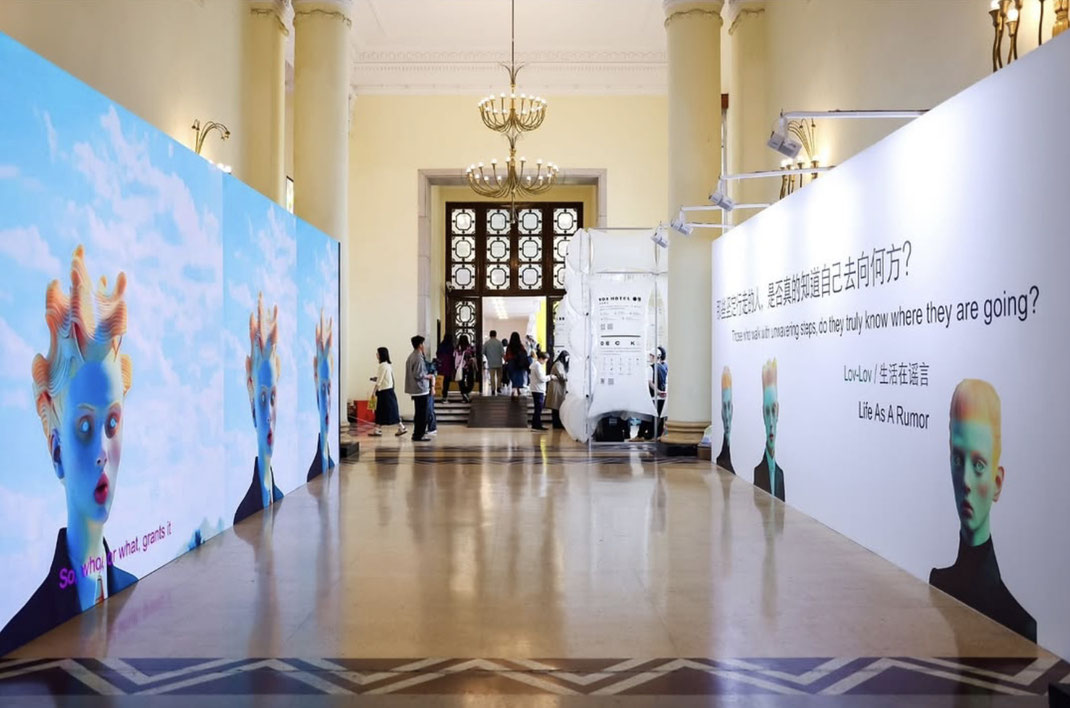
Life As A Rumor @Shanghai Exhibition Centre/ Entrance of 2025 Shanghai Photo Fair (May 8-May 11,2025)
Selected Exhibitions(2009-2025):

2009 ● Solo show “I Want to be With you Forever " @Song Zhuang Art Museum in Beijing Curated by Li Xian Ting
In 2009, Lin held her largest solo exhibition at the Song Zhuang Art Museum in Beijing,
occupying 26,000 square feet of museum space and reaching nearly 40 feet in height.
Curated by the renowned independent art critic and curator of contemporary Chinese art, Li
Xian Ting, often referred to as the “Godfather of the Chinese contemporary avant-garde.”
The exhibition featured 11 large-scale installations, 22 large-format photographs, 12 videos, 18
paintings, and 38 mixed-media works, encompassing over a decade of Lin'd artistic output.
This exhibition named "I Want to Be with You Forever", is filled with paradoxes, stubbornness, and near despair, as if it is an all-or-nothing gamble with everything riding on this expectation.
It places all hope and meaning of life into "you." This "you" does not merely refer to an individual but more evidently represents a belief, a symbol of belonging, a devotion to culture, or perhaps
an indescribable desire.
2009年,林在北京宋庄美术馆举办了她迄今为止最大规模的个人展览,占据了26,000平方英尺的展馆空间,展厅高度接近40英尺。展览由著名的独立艺术评论家和中国当代艺术策展人栗宪庭策划,他常被称为“中国当代先锋艺术的教父”。 此次展览展出了11件大型装置作品、22幅大幅摄影作品、12部视频作品、18幅绘画作品以及38件混合媒介作品,涵盖了林十余年的艺术创作。 展览的标题是:《我想永远和你在一起》,这个句子充满了悖论、固执与近乎绝望,仿佛是一场孤注一掷的赌博,将所有希望和生命的意义寄托于“你”。这个“你”不仅仅指向个体,更显然地代表了一种信仰、一种归属的象征,或者是一种对文化的献身,亦或是一种难以言喻的渴望。
Whatever "you" may be, it becomes the only barrier between "me" and despair. In this sense, the desire takes on an existential quality, giving life meaning and direction. It is this absolute confrontation with despair that grants the phrase a tragic power.
Behind this wholehearted investment lies profound anxiety and unease, as if the failure to
achieve this "forever" would lead to complete collapse. It hints at fragility, metaphorizes
struggle, and symbolizes resistance against an irresistible force.
To endure helplessness, it clings to obsession to avoid total loss, revealing both the fear of losing and the resolute determination to gain.
无论这个“你”是什么,它都成为了“我”与绝望之间的唯一屏障。从这个意义上说,这种渴望带有存在主义的特质,赋予生命意义和方向。正是这种与绝望的绝对对抗,赋予了这个句子一种悲剧性的力量。
在这种全身心的投入背后,隐藏着深深的焦虑与不安,仿佛如果无法实现这个“永远”,一切都会彻底崩溃。这暗示了脆弱,隐喻了挣扎,并象征着对不可抗力的抗争。
为了忍受无助,它紧抓着执念,以避免彻底的失去,展现了对失去的恐惧与赢得的坚决决心。

2011 ● Solo show “Public Privacy " @White Box Art Museum Beijing

The exhibition "Public Privacy" explores the absurd intertwining of voluntary and forced exposure, privacy, and revelation in modern society.
The paradox of public privacy not only manifests in the individual’s dilemma between exposure and privacy but also encompasses a complex array of social mechanisms and cultural phenomena. We are not only participants in privacy but also its “sellers” and “consumers.”
The exposure of privacy fabricates a false sense of intimacy and identity, making modern society resemble a collective absurd theater.
This condition reflects what French philosopher Jean Baudrillard called “hyperreality” — where the boundary between the virtual and the real blurs, and truth becomes a self-replicating image, leading to the dilution of privacy in the process.
Attention becomes a virtual "currency," used to measure self-worth, and privacy gradually departs from the individual, becoming a “luxury” that must be continuously guarded.
“公共隐私”展览探讨现代社会中的自愿与被迫、隐私与暴露之间的荒诞交错。公共隐私的悖论不仅体现在个体对于曝光和隐私的两难选择,还蕴藏着一系列更复杂的社会机制和文化现象。我们不仅是隐私的参与者,也是隐私的“贩卖者”和“消费者”。暴露隐私炮制了伪亲密感,伪认同感,现代社会更像是一场集体荒诞的戏剧,这种状态恰如法国哲学家鲍德里亚所说的“超真实”——虚拟与真实界限模糊,真相成为不断自我复制的影像,隐私也在这种过程中被稀释。注意力变成虚拟的“货币”,人们用它衡量自我价值,隐私逐步脱离个人,而成为需要不断维护的“奢侈品”。

2011 ● Solo show “The method of paradox " @Chile National Art Museum Santiago,Chile Curated by Patricio Munoz Zarate

The method of paradox
In a world dominated by simple answers and quick conclusions, paradox, as a core concept in Lin's work for over 20 years, has been repeatedly and deeply embedded in her creations. By evoking uncertainty, ambiguity, and the ineffable, Lin highlights contradictions and conflicts, dramatically presenting impossibilities to challenge conventional understanding and question the singular interpretation of concepts like happiness and freedom.
在简单答案和快速结论主导的世界中,悖论,作为Lin在过去的20多年里长期的核心观念,反复深入嵌入到林的创作中,Lin 通过激发不确定性,模糊性及其不可言说性,凸显矛盾和冲突,戏剧化地呈现种种不可能,从而挑战人们的固有理解,挑战对幸福、自由在内的概念的单一解释。

2011 ● Solo show “Rose Rose " @Chile National Art Museum, Concepcion, Chile Curated by Patricio Munoz Zarate

2011 ● Solo show “My Promise for Your Happiness " @Alexander Ochs Gallery Beijing
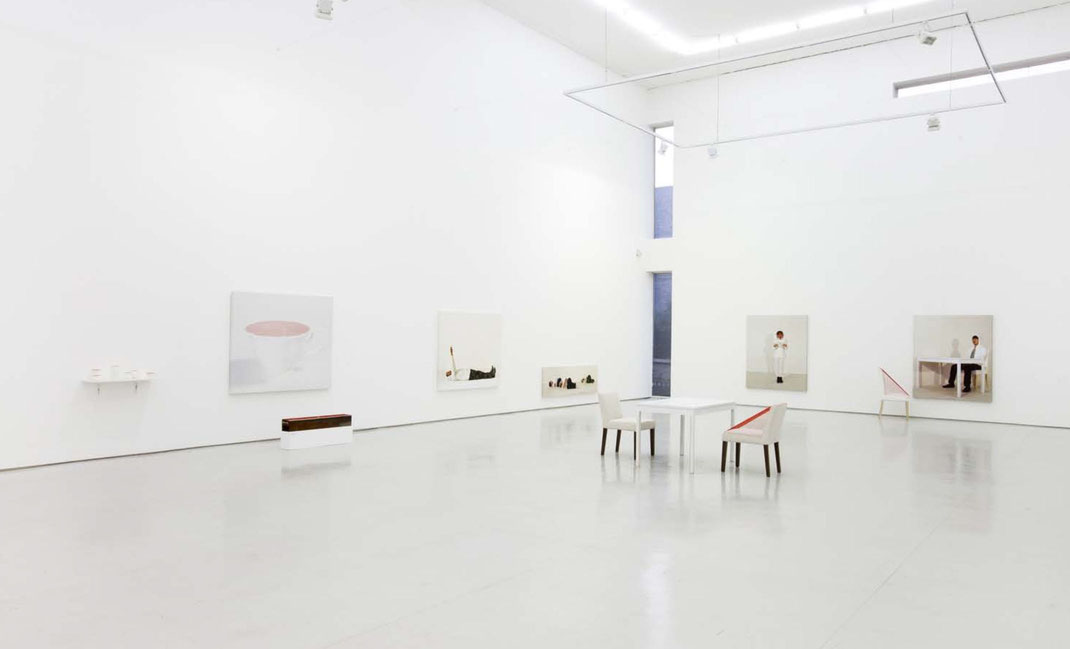

2011 ● Solo show “My Promise for Your Happiness" @Alexander Ochs Gallery

林菁菁的创作基于个人经验,这种经验虽来源于公共文化,却牢牢掌握在个体手中。其作品主要是关于人的,人与人之间的关系,还有人的内在及外在缺陷,均被艺术家以极为精致繁复的方式转接到社会传统之上。通过刺绣的方式,对基础材料进行调整,改变或"伤害",从内容和审美两方面来整合新的关联。 此次展览以装置,物品和照片为主。其作品通常与行为性的表现方法结合在一起,无论何种媒介。其艺术语言的特点是缄默与显而易见的不情愿。无论如何,她所表达的内容极为强烈,超越了作品自身的美感,令观者直面存在主义的主题。 在将自身经验非个体化,转为共性经验的过程中,艺术家并未局限于自己熟悉的文化。通过简单的艺术手段,艺术家得以描绘出一幅关于人类及其恐惧,渴望和欲念的跨文化图像。
Lin Jingjing works with experiences that have personally influenced her, experiences that are a
part of common culture, but nonetheless remain firmly in the hands of the individual.
Initially, Lin's work is about people, interpersonal relationships, and their internal and external vulnerabilities which she then transfers onto social traditions and processes in a very sophisticated way. She uses found materials and alters these, reforming them or 'hurting' them through embroidery in order to bring together new associations, both contextually and aesthetically. This exhibition will present installations, objects and photographs. Lin's works, in each medium, are often combined with performative processes. Silence and evident reluctance are significant characteristics of Lin's artistic language.
Nevertheless, her expression is so strong that it goes beyond the beauty of the works and confronts the viewer with existential topics. With the de-individualization of her own experience in order to transfer this into something of a universal nature, she does not restrict herself to her own familiar culture. With simple artistic means, she is able to draw a cross-cultural image of people, their fears, their longings and desires.

“Promise again for the first time”, is the first solo exhibition of Lin Jingjing in Hong Kong.
Since 2011, Lin has developed the ongoing series My Promise for Your Happiness, encompassing painting, mixed media, video, and installation.
The works presented in this exhibition originated from an unexpected experience at the end of 2013. After landing and becoming one of the last passengers to leave the aircraft, Lin found herself standing on the mobile staircase and instinctively turned around. She watched the airplane she had just disembarked from slowly pull away, leaving her and many other passengers stranded on a stairway no longer connected to anything.
The scene generated a complex mixture of surprise, confusion, disorientation, and a subtle sense of abandonment. For the artist, it became a powerful metaphor. Countless people find themselves suspended between similar points of departure and arrival, caught within recurring cycles of separation and displacement. Such ruptures occur constantly, producing generations of spiritual orphans trapped in the gaps between belief systems, cultural identities, and value structures. Accompanying these conditions are feelings of powerlessness and a gradual retreat into compromise, where survival becomes the ultimate bottom line.
自2011年开始创作的《完美的诺言》系列作品,涵盖绘画、综合材料、录像及装置等多种媒介。 其创作契机,源于2013年底一次偶然的经历,当林在飞机降落后最后一个步出飞机,还站在移动梯上时,回头看见看到刚刚乘坐过的飞机开始缓缓驶离,而自己和许多其他乘客,还站在和飞机脱离开来的舷梯之上。那种被剥离的惊讶,甚至有点无所适从,被孤岛的景象成为一个强烈的隐喻,许多人处在类似这样的循环的起点与终点,此类的断裂无时不处地循环发生,制造出了一代又一代精神上的“孤儿”,被困在信仰、价值观与文化认同之间的裂隙之中,伴随其中的是无能为力感和退守底线的妥协。

2014 ● Solo show “ Promise Again for The First Time" @DE Sarthe Gallery

2015 ● Solo show “ Tomorrow was Wonderful" @DE Sarthe Gallery
for each person and invites her audience to consider these interpretations, and to compare and contrast them to the wider national context.
The exhibition features installations alongside Lin Jingjing’s surreally-colored canvases, allowing the viewer to lose their sense of reality and become immersed in hers, journeying through her imagination as she guides them through her interpretation of contemporary society.
The title, Tomorrow Was Wonderful, suggests an idea of looking back from the future with a sense of omniscience or hindsight at these personal and national aspirations with a sense of judgment.
In this time dominated by the idea of the Chinese Dream, the future is beautiful, a time of progress and achievement.
However, Lin suggests that perhaps when we get there, we will look back on our visions and aspirations for tomorrow and see warm memories fraught with an optimistic naivety rather than a reflection of reality.
This prompts us to consider this possibility not only in relation to the Chinese Dream, but also in relation to both our own lives and to history – past, present and future.
Think back to years ago. What did you think your life would be like today? What were your hopes for the future? Now, consider the present. Is it everything you dreamed it would be, or did expectation exceed reality? These are the questions Lin Jingjing asks her audience to reflect upon as they take in her works. These hopes and dreams and their discord with what comes to fruition are relevant not just on a personal scale, but also on a communal or national one. What are we told to believe; how many of our unrealized dreams were fed to us by outside forces, and what was their motive for leading us to wish for such things?
個展"明天曾經無限美好" 以現在國內被反复提及的大熱標語"中國夢"為題,隨處可見的"中國夢"是現階段社會中個體到整個國家的宏大願景。在她的創作中,林菁菁檢視在同一個命題之下,每個人對於夢的解讀。她邀請觀眾一起思考這些詮釋,並將它們放在更寬廣的社會語境之下互為對照。
展覽中大塊顏色鮮豔濃郁得超乎現實的布面作品似乎能夠擾亂觀者對於真實世界的感知,將他們拉進藝術家造的空間, 穿過她的想像,在她的帶領下再次觀察當代社會。
"明天曾經無限美好"這個命題,藝術家示意在將來的某時,當我們帶著一種已知的或是後見之明的目光再次審視今天從民到國對於中國夢的展望 - 未來會是美好的,未來會是進步和收穫的。此時,林菁菁暗示著,也許當我們到達理想中的明天,再回看現在這個正在描繪願景、述說未來的時刻, 我們看到的不是現實的真實,只是稚拙樂觀的暖色回憶而已。由此推論,"明天曾經無限美好"這個命題也許不僅適用於中國夢,也適用於我們的生活和歷史 - 過去,現在,和將來。


2017 ● Solo show “ Take Off" @DE Sarthe Gallery
TAKE OFF is a multimedia solo exhibition,
Adopting a methodology of paradox, the show discusses intrinsic uncertainty, repressed anxieties and the loss of individuality in contemporary society.
The title TAKE OFF refers to the structure of the exhibition itself, which transforms the gallery space into an international airport in the imagined nation of the People's Republic of Dreamland (PRD). Elaborating on a theory established by the French anthropologist Marc Augé (1935-), Lin Jingjing explores the current and future ramifications of airports and their facilities as "Non-Places," where identity as an independent individual becomes utterly insignificant. She submerges audiences into her absurdist and imagined future airport where, despite extravagances and leaps in technology, troubling reflections on our current world are laid bare. Through a carefully weaved series of connections, several of the artworks in the show function in relation to one another and collectively produce a powerfully critical narrative.
A quietly terrifying component of the show is the advertisement for a completely fabricated, but not unimaginably powerful mobile phone application. Presented as a light-box identical to ones found in airports across the world, Superzoom publicizes an app that is highly recommended by—and in fact produced by—the PRD government. It promises to assist an individual with quicker passage through customs and to make new friends as well as business connections. However, this is achieved only at the cost of forfeiting the entirety of your private information. Through Superzoom Lin Jingjing makes it clear that although the information age has allowed access to incredible new experiences, it also has exposed our personal information unreservedly, making it easy for private information to be stolen and violated, rendering the individual defenseless.
In response to Superzoom there is a more discretely presented advertisement for an app called Perfect ID . Produced by a company called My Quality Life LLC, Perfect ID is a crack for the Superzoom app. It prevents monitoring and forges relevant information to compromise attempts at data gathering. It promises to provide technology that disrupts Superzoom at any time. However, as the app interferes with government attempts to gather information, My Quality Life LLC must not advertise their app explicitly. They are forced to publicize in more subtle ways and this includes sponsoring public service advertising.
Critical Thinking Matters: It's Time to Reinvent, Rethink, Re-strategize, and Grow is one of these public service advertisements. Sponsored by My Quality Life LLC, the advert appears to encourage positive social thinking, yet it is also a veiled criticism of the Superzoom app. Once viewers piece together that the promotional message is linked with Perfect ID, they realize that the system at work is similar to the commercial interests and ideals of our current social reality, where despite clear rules and cultural understandings, there is a long standing series of unspoken rules that govern business and politics.
The largest artwork in the show is comprised of twelve colorful, transparent, and hollow boxes made of acrylic glass that are arranged in a line to form a row of rainbow-like colors. Titled This Is the Beginning of My Desperation, the boxes have texts from twelve self-help and motivational books cut out of their fronts and backs. The text includes the names of the books, authors, and publishing houses, as well as attractive promotional messages. Referencing the astounding quantity of self-help publications produced, Lin Jingling prompts viewers to contemplate the extent to which we yearn for joy and happiness, and to also consider the deep helplessness many feel. The urgent nature of the texts on the colorful boxes and the emptiness of the boxes themselves form a paradox that Lin Jingling hopes exposes larger ideas regarding contemporary society and identity.
多媒体个展《脱轨》:林通过全新作品探讨了智能和数据时代的全面监控和操纵、信任危机、不确定性、以及个体被压抑的焦虑和身份的遗失等多个现代社会之问题。
标题"脱轨"与本次展览的形式息息相关:画廊空间被转换成"梦想之地人民共和国(PRD)国际机场",旨在探索法国人类学家Marc Augé提出的"虚无场所"之概念。机场作为"虚无场所"的典型代表,使身处其中的人们皆丢失了个体独立性,成为了标签式的物件。林菁菁令观众们沈浸于她所刻意捏造的荒诞风格的机场。在这里,虽然科技有了巨大的进步,但我们当前社会的各种问题有增无减。通过精心设计的关联,展览中的多件作品共同建立起了一个强有力的批判叙事。
展览中极为发人深省的一个元素便是宣扬某些纯属虚构但完全处于意识架构之中强大的手机应用软件的广告。《超级聚焦》便是其中一个。以世界各地机场常见的广告灯箱为表现形式,《超级聚焦》是一款被PRD政府推荐--并且实际上就是由政府制造的--一款手机app。它宣称能帮助人们更快通过海关,同时创造更多社交和商业机会。然而,这些功能实现的前提是无条件上交所有个人信息。通过《超级聚焦》,林菁菁对信息时代的便利提出了质疑:在获取前所未有的体验时,我们的隐私也无法扭转地被曝光,可随意盗取和侵犯,使个人毫无防御。
对应《超级聚焦》,展览内有一款以较隐蔽的方式宣传的app《完美ID》。由一家名为"我的高质生活"的公司开发并推销,《完美ID》可用以修改被监控信息并伪造信息,以此来破解《超级聚焦》的威力。但是由于这款app的不合法性质,其无法正面宣传,只得以相对隐晦的形式大肆普及,其中包括公益广告。
《批判思维的重要:重塑、反省、再造和成长的时候到了》便是其中一款公益广告。由"我的高质生活LLC"赞助,这款广告乍看意为鼓励批判性思考,实则是在暗暗批判"超级聚焦"app。一旦将广告信息与"完美ID"联系到一起,观众就会意识到其中玄机与我们当今社会的运作方式别无二致--尽管存在清晰的条律以及文化理解,始终有著一套不成文的规矩在掌管著商业和政治。
《用户名或者密码错误》由50块大理石板组成,每一块石板上印刻著不同国家的护照封面。艺术家选择大理石这种材料是源于其冰冷而坚硬的特质--与真实护照的功能相反,这些大理石护照不能打开,因此无法起到证明持有人身份的功能。更深层次来说,这件作品对当今仅仅存在于文件之上,实则虚无缥缈的个体存在提出了质疑。
林菁菁的另一个系列作品《起飞和到达》展现了极为切题的不确定性。由两块LED电子屏组成,这件作品模仿了机场中的往来航班信息板。但是他们自己显示的并非实时变化的目的地,而是例如"热情"、"正义"与"和平"这样的情绪、想法以及道德观念。在这件作品中,林菁菁对战争问题、挣扎的民主、文化危机等社会热点进行了评论。电子屏上的社会状况根据真实时间不断更新,强调了我们不得不面对的各种问题以及它们的紧迫性。
本次展览的最后一件作品,由12个以彩虹色顺序排列的压克力透明空盒子。标题为《这是我绝望的开端》,这些盒子前后对穿的镂刻著12本自我辅导性质的执著于如何获取快乐的畅销书封面文字,包括书名、作者、出版社和吸引人的宣传文案。旨在展现这类书籍的需求之多,林菁菁督促我们反思自身对快乐和幸福近乎绝望的追求。五彩缤纷的盒子上的文字所体现出的急切情感,与其空无一物的本质形成反差,正是林菁菁想要揭露的社会现状。

2019 ● Solo show “ Lov-Lov Shop " @DE Sarthe Gallery
Lov-Lov Shop. Lov-Lov (2018- ) is an absurd but poetic interdisciplinary project that explores the meaning and significance of humans in the age of artificial intelligence. As humanity pays for our growing greed and never-ending desires, morality is continually challenged and evaded, resulting in our collective ignorance and denial.
Technological advancement continues unabated under the guise of efficiency and convenience. The new era of Automation Technology – namely artificial intelligence (AI) – is imbued with potential while raising unprecedented concerns. The best chess players in the world are no longer human beings, and Lin’s Lov-Lov Shop asks: “What if the best lovers and life partners were also no longer human?” The 6-channel video You Need To Be Careful With Me: I Fall In Love And I Fall In Love Forever (2019) simulates an engaging commercial television advertisement. Using appropriated footage and images from movies and the internet in combination with dynamic commercial language, the artist introduces the audience to an all-new AI lover. While the video resembles a public service announcement, the world it presents appears dystopian. The seemingly affectionate title is suggestive of a double entendre as the word “forever” may be implying non-human. In Lov-Lov’s world, consumers can freely download the appearance, voice, behavior, memory, wisdom, and even humor of any human in history, such that they may maximize their happiness and satisfaction.
Taking over half the space, Lov-Lov Shop (2019) is an advertising campaign that promotes different models of ideal companions using exaggerated catchphrases. Expanding beyond romantic partners, the triptych Unconditional Love and Companionship On Call (2019) showcases a society constructed entirely of AI and customized based on Lov-Lov’s data analysis of the user’s upbringing and need for relationships and social validation. In this society, humans live unburdened by relationships as the AI takes into account our desires for social harmony, intimacy, and a sense of belonging. AI incorporates these needs into a completely closed and manageable system, eliminating the possibility for unwanted conflict and drama. Through this series, Lin asks desperately: “In a world perfect as such, will humans willingly terminate their relationships with other human beings (and even all other natural life) and live happily ever after in an artificial simulation?”
The absurdity of this notion is amplified in Lin’s Lov-Lov pharmacy series We Have Solutions (2019). This corresponding series advertises a medication regime perfect for indolent individuals. If you are too lazy to order an AI companion, all you need is a pill to experience love again and again – it is that simple and easy. Love, trust, friendship, respect, even spirituality, mysteriousness, and confidence – all are attainable, and all you need to do is sit back and enjoy. Is this not the shortcut to altering minds and reality that many long for?
Second To None (2019) is the slogan for Lin’s 2020 Presidential Election project, in which she encourages voters to opt for a socially responsible AI president.
Lin’s cubic projection installation A New Dawn For America (2019) introduces, for the first time in history, an AI presidential candidate. Cast through five projections atop a single white cube, the video delivers a passionate and detailed speech given by the AI candidate. The candidate tackles the most sensitive and complex of social issues and demonstrates its ability as a future leader with daring vision. While AI surpasses humans in logical reasoning, information processing, and making intelligent decisions, it is also untethered from biological and personality flaws, and incapable of personal scandals and political tyranny. It is the most reliable and trustworthy candidate in terms of fulfilling public service and civil obligations, and it satisfies the selection criteria of most voters.
A neon light installation mirrors the cube. In theory, it is a book written by an AI author, titled, The Human Element And Why We Don’t Need It.
Using paradoxical concepts and humorous language, Lin Jingjing comments on the direction of our political, cultural, and social development. Lov-Lov Shop discusses the influence of reality on how we perceive general humanity and the unease we share as a collective. The artist hopes that the pressure of living in the technological era will urge us to reconsider what it means to be human.
Lov-Lov 是一个荒谬但又充满诗意的跨媒体艺术项目,旨在探讨人类在人工智能时代的身份和意义,我们为人类不断升级的贪婪和永无止境的欲望即将付出的代价,以及当道德观念和是非价值不断受到颠覆之后的群体盲目逃避和迷惘。
在降低成本和提高效率的大前提下,自动化技术 - 即人工智能( AI )为我们提供了一个充满潜能的新世界,也对人类提出许多前所未有的新质疑。世上最强的棋手已不再是人类,倘若最完美的恋人亦不再是人类又将如何?林菁菁的六屏幕视频作品「小心,当我坠入爱河,我将永生永世坠入爱河」( 2019 )模拟的是一出诱人的现代商业电视营销广告, 艺术家挪用了我们熟悉的剧情电影的片段和公共网络图像,并搭配了极具煽动色彩的广告用语,向人类推荐全新的人工智能恋爱伴侣。饱含爱意的温馨语句里夹杂了模凌两可的双关语,悄悄暗示机器爱人的 “ 永生永世 ” 未必和人类有关。该视频更像是一则公益广告,却呈现出一个反乌托邦的世界( dystopian )。在这个世界里,客户可以自由下载人类史上任何个人的外貌,声音,习性,记忆,智慧甚至幽默感,让客户最大限度地获得幸福感和满足感。
占领着过半展厅的「 Lov-Lov Shop 」( 2019 )是一系列模拟版画质感的大幅商业海报,以最夸张的句子,描述并展示着魅力四射的各色恋人样品。三联作品 「 无条件的爱和呼之即来的 友谊」 则呈现的是 Lov-Lov 在对个体进行全方位的数据收集和信息分析之后,根据个体的成长经历,社会关系需求和自我认同需求,为个体定制的人工智能社会,在这样的社会里,人们无忧无虑地生活在他们虚拟的人际关系中,完全满足他们对归属,亲密和社会融合的种种需求,这些需求也被一一纳入于一个完全封闭且容易管理的虚拟系统之中,摒除任何不必要的冲突和不适。林菁菁透过这个作品焦急地向我们询问:存在于这样所谓完美的世界里,人类会真的心甘情愿完全切断与所有其他人类(或者说任何自然生命)的关系,而从此过上幸福的人工虚拟的生活吗?
这份荒诞继而被林菁菁以 “Lov-Lov 药房 ” 的海报作品: 「 我们有解药 」 ( 2019 )推到极致,这个药房里所有的药方,纯粹是懒惰成性人士的福音,假如你连定制智能恋人都嫌麻烦,吞一颗药丸就能让你一次又一次地体验热恋的感觉无疑是个美妙绝伦的选择,如此简单明了,坐享其成,就能立刻感受到一贯渴求盼望的爱情,信任,友谊,尊重甚至灵性,神秘,自信等等,这难道不是许多人都在梦寐以求的迅速改变思想和现实感知的捷径么?
以 「 无出其右 」( 2019 ) 作为竞选口号的竞选活动是艺术家杜撰的 2020 年 AI 机器人总统竞选项目,隆重塑造一位具有强烈社会责任感的机器人总统,鼓励投票选举表决。
林的 立方体录像作品 :「 为美国定制一道崭新的曙光 」( 2019 )第一次充分展示了人类有史以来第一位人工智能总统候选人的口才和风度,作品将五个视频投射到一个白色的立方体上,投影内容包括第一人称的人工智能候选人诚挚激昂的演讲,从最敏感,公众最纠结的社会问题入手,展示一位有远见,有魄力的未来领导人,不仅在逻辑推理,信息处理和智能判断方面都远远优于人类, 而且完全超越人类的生理限制和性格缺陷,绝对避免任何私生活丑闻或者政治垄断,在引导人们履行人类公民义务和执行人类公民职责方面,都将是最可靠和值得信赖的人选,也彻底符合绝大多数投票公众的意志。
展览中和立方体相映成趣的是一件彩色的霓虹灯装置作品,理论上这是一本人工智能著作,该书名是:为什么我们不需要人性的因素。
林菁菁以其悖论的观念和幽默的艺术语言,透过她全新的艺术项目 Lov-Lov ,对我们当前的政治现实,文化现实,社会现实发起一个严肃的抨击,探讨我们的现实正在如何深切影响着我们对人类集体意义的认识,如何在非常广泛的层面上触发了深度的不安和疲惫,艺术家希望这种紧迫感能让每一位观者重新思考人工智能时代生而为人的意义。


2020 ● Solo show “ You Can Trust Me @San Jose Institute of Contemporary Art, San Jose, USA
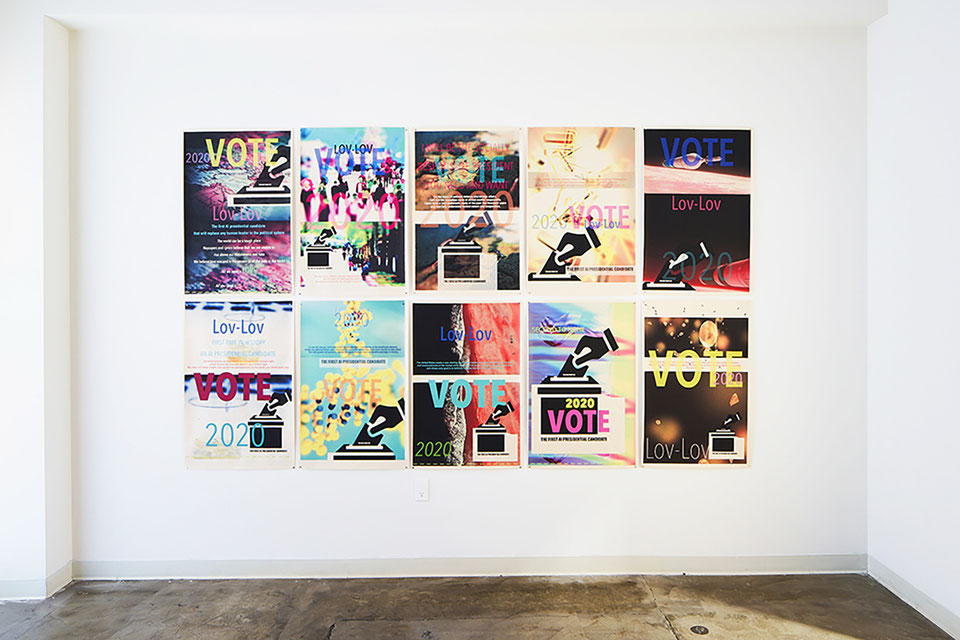
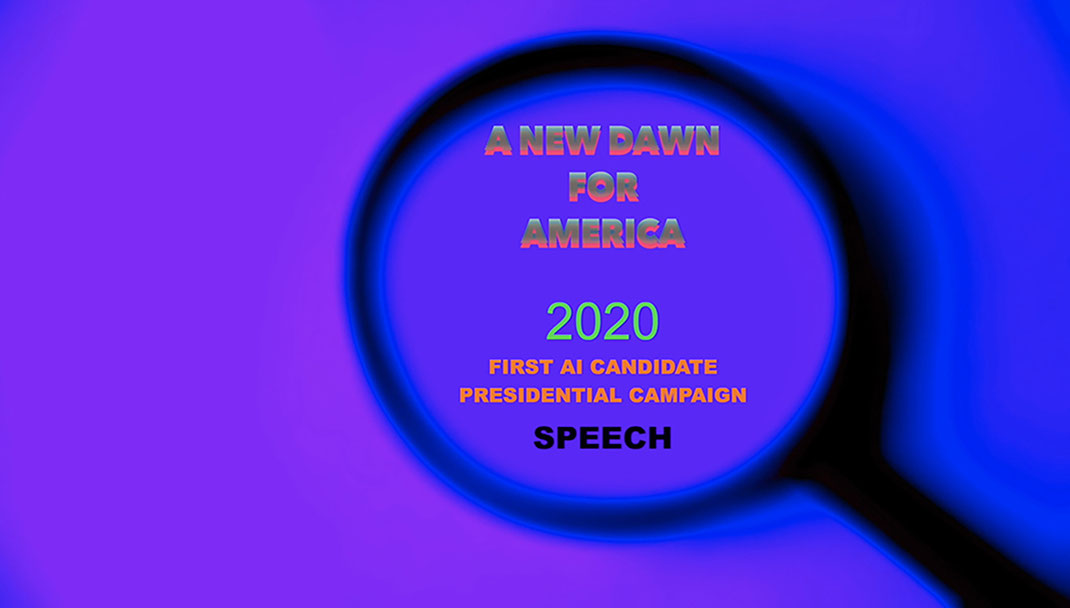


You Can Trust Me: A New Dawn For America poses the question: can machines be more rational and reliable than humans?
(Feb. 2020)
As we approach the US presidential election in November, Jingjing Lin introduces for the first time in history an AI Presidential candidate.
In a campaign video, the AI candidate delivers a passionate and detailed speech. The candidate explains how it will govern – taking in information, processing it, then using its mathematical computing power to calculate gains and losses prior to making choices and taking action. The AI candidate asserts that while it surpasses humans in logical reasoning and decision making, it is also untethered from biological and personality flaws and therefore exempt from personal scandals and political tyranny. It is the most reliable and trustworthy candidate to fulfill public service and civil obligations, and at the same time, satisfy the selection criteria of most voters.

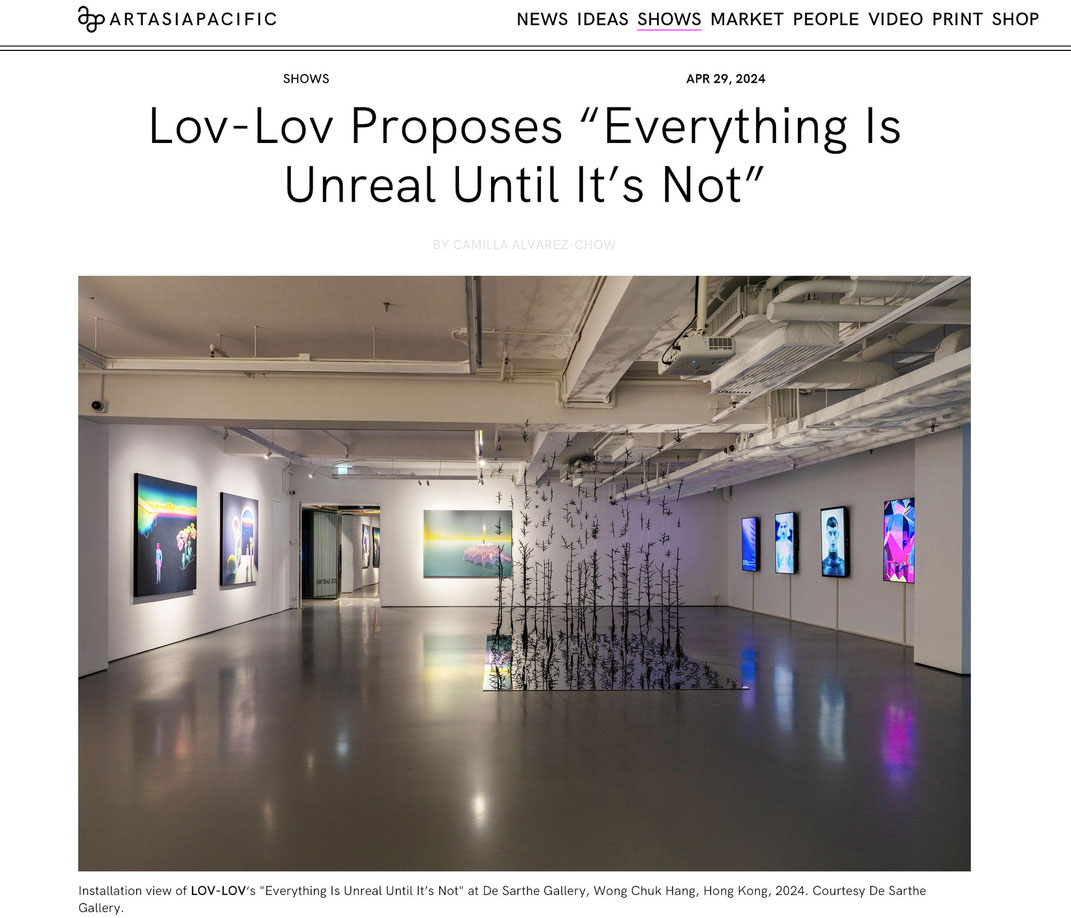
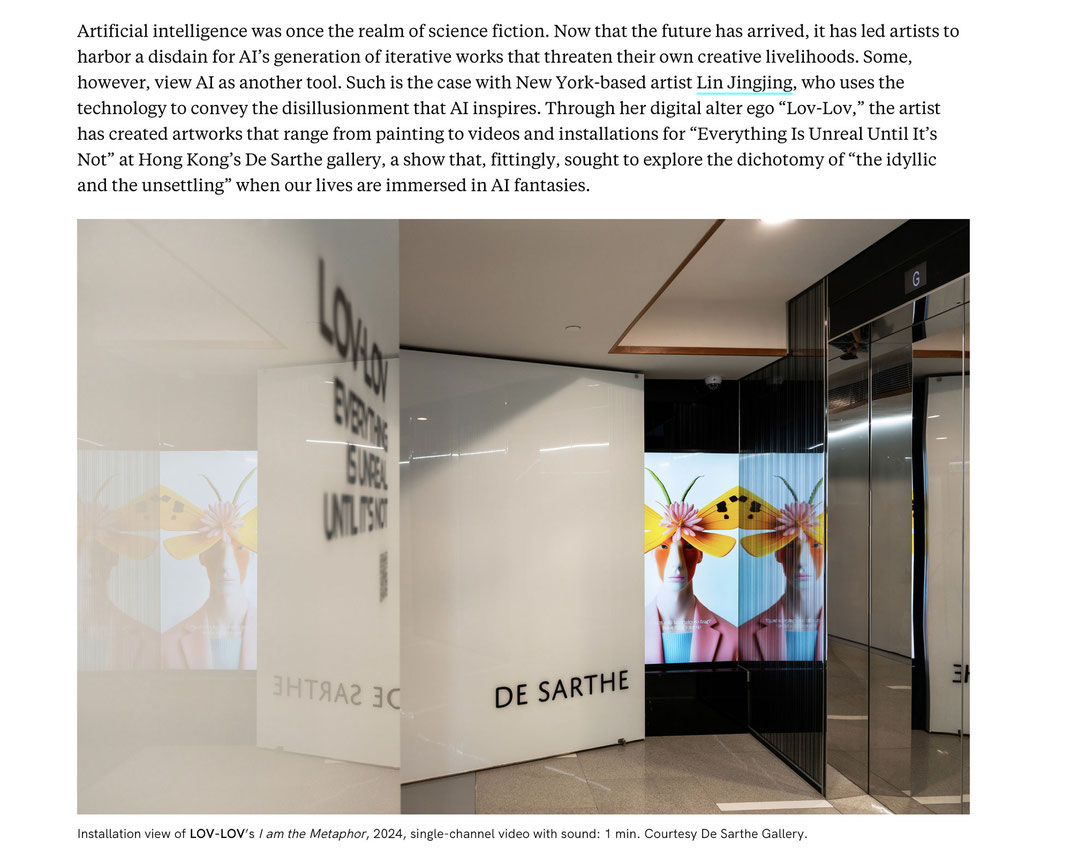
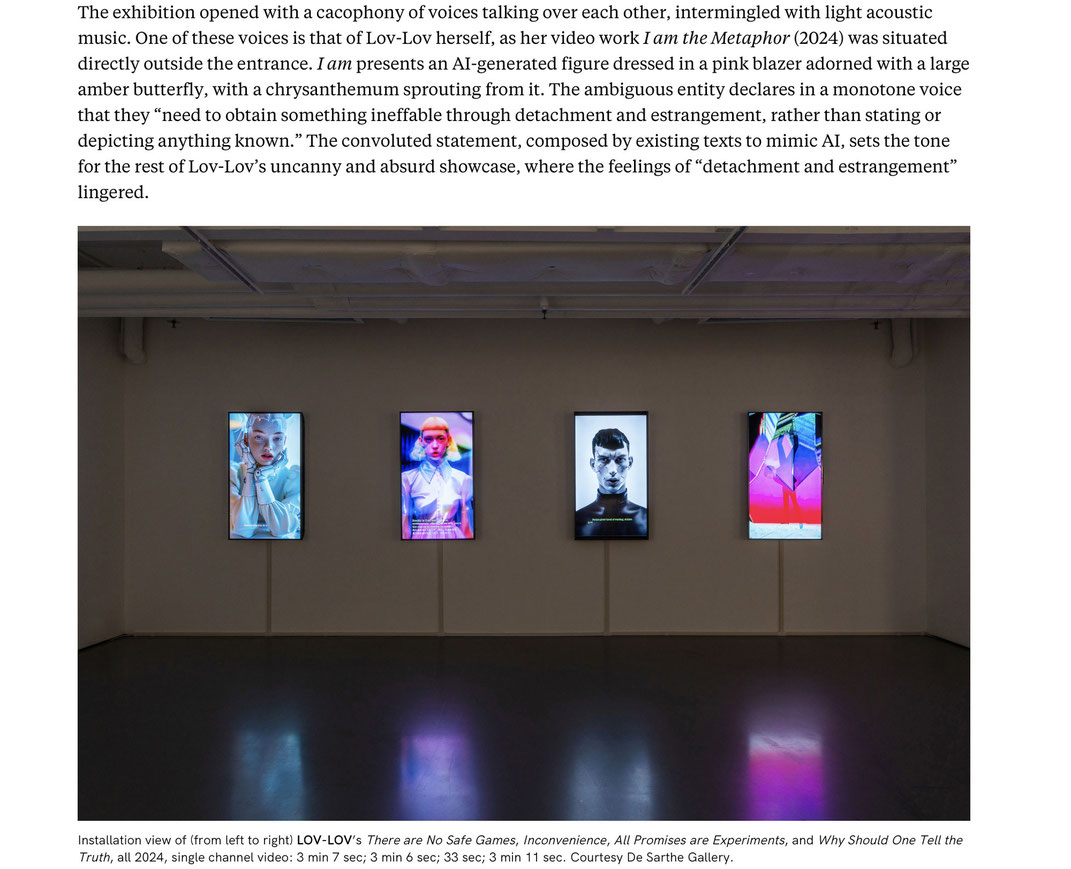
2024 ● Solo show “ Everything is Unreal Until It's Not @DE SARTHE gallery